How to Check All Your Car's Fluids in 15 Minutes
Pop the hood, check six fluids, and you will know more about your car's health than most owners ever learn. This takes about 15 minutes, needs no tools beyond a rag and a flashlight, and catches the problems that strand people: low oil, low coolant, and brake fluid that has gone bad. Do it on level ground with the engine off and cool, and keep a rag in one hand because you will be wiping dipsticks.
Before You Start
Park on flat ground, set the parking brake, and let the engine cool. A hot engine gives false readings on some dipsticks, and opening a hot cooling system can burn you. Never open the radiator cap on a hot engine. The overflow reservoir is the safe place to check coolant level.
Bring a clean rag or a few paper towels, and your phone flashlight. If your owner's manual has a diagram of the engine bay, open it. Every car puts the reservoirs in slightly different spots, and the manual shows you exactly where yours are. Check your owner's manual for your car's fluid types and service intervals before you top anything off.
1. Engine Oil

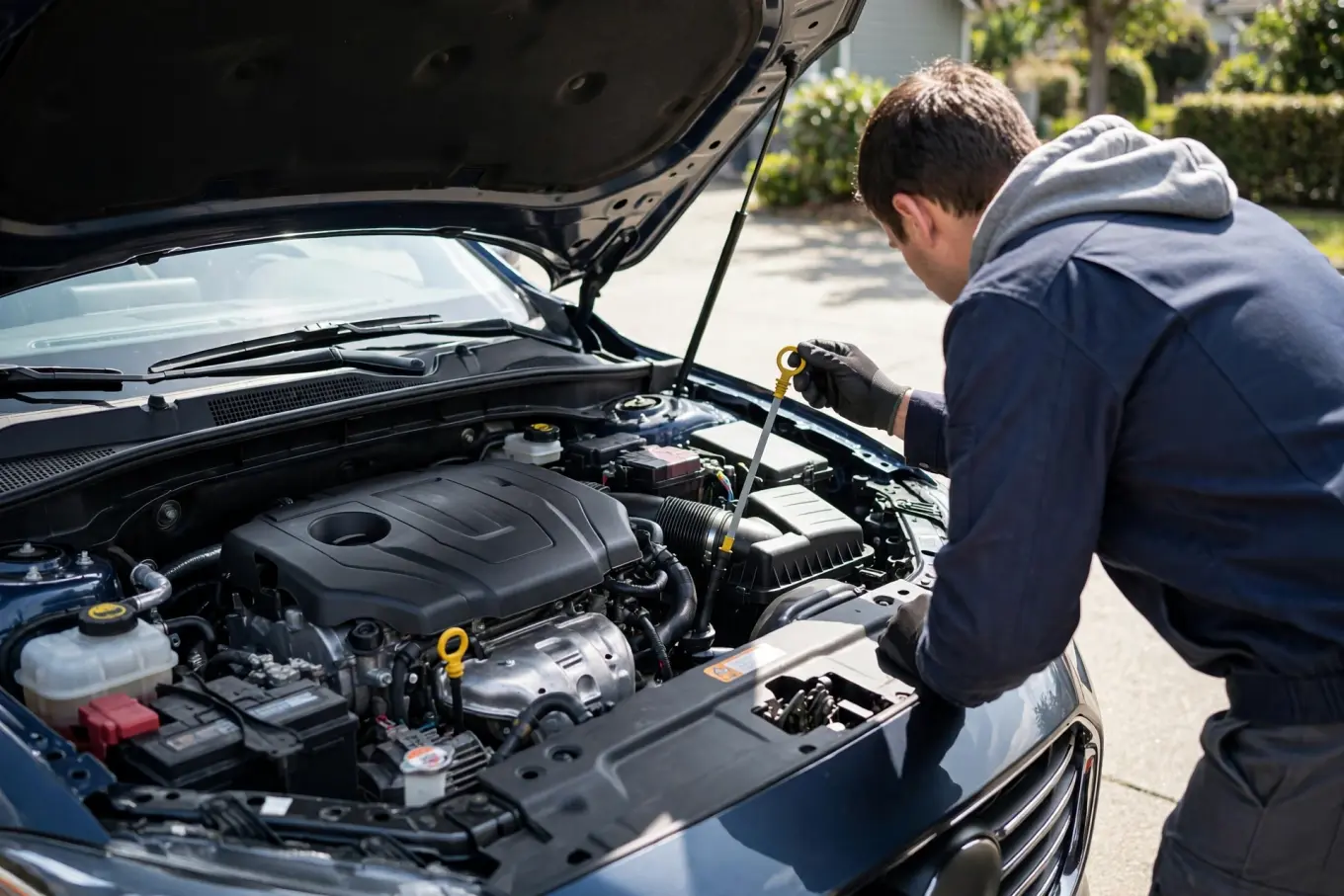
Engine oil is the most important fluid to check, and the one most people skip. Pull the dipstick, wipe it clean with your rag, push it all the way back in, then pull it out again and read it. The second pull is the real reading. The first pull just shows splashed oil.
The level should sit between the two marks on the stick, usually labeled MIN and MAX or shown as a crosshatched zone. If it is at or below the low mark, add oil. Check your owner's manual for the correct oil type, add a little at a time, then recheck.
Now look at the color. Fresh oil is amber and translucent. Oil that has been in the engine a while turns darker, and that is normal. What you do not want to see is oil that looks like chocolate milk, which can mean coolant is mixing with the oil, or oil full of grit and metal specks. Either one means stop topping off and get the car checked.
If your car has no oil dipstick, and some newer models do not, check the level through the dashboard display or the electronic oil monitor described in your owner's manual.
2. Coolant

Coolant keeps your engine from overheating in summer and freezing in winter. Check it in the overflow reservoir, the translucent plastic tank near the radiator, not by opening the radiator cap. The reservoir has FULL and LOW marks on the side. The level should sit between them when the engine is cool.
Look at the color too. Coolant comes in several colors depending on the car, and the color itself is not a quality test. What matters is whether it looks clean and translucent, or rusty, brown, oily, or full of floating bits. Rusty or oily coolant means something is wrong in the cooling system and needs a proper diagnosis.
If the level is low, top it off with the coolant type your owner's manual calls for. Do not mix coolant types. If you keep finding the level low after topping it off, you have a leak or the engine is consuming coolant, and that needs tracking down.
Read Coolant Flush: Why It Matters and How to Do It Without Making a Mess for the full flush walkthrough, or the vehicle-specific 2018-2024 Chevrolet Equinox Coolant Flush guide.
3. Brake Fluid

Brake fluid lives in a small reservoir on top of the master cylinder, usually on the driver's side at the back of the engine bay. The reservoir is translucent with MIN and MAX marks. The level should sit between them. Do not open the cap unless you need to add fluid, since brake fluid absorbs moisture from the air, and moisture is what degrades it.
Fresh brake fluid is light and clear, often pale amber. Fluid that has turned dark brown or black is old and contaminated and should be flushed. If the level is low, that is a symptom, not just a top-off job. Brake fluid does not get used up the way oil does. A dropping level usually means worn brake pads or a leak somewhere in the system, and a leak in the brakes is not something to ignore.
See Brake Fluid Flush: When You Need One and Why It Matters for when a flush is due and what it involves.
4. Transmission Fluid
Transmission fluid is the trickiest check on this list because cars differ so much. Some have a dipstick like the engine oil one, usually further back in the engine bay. Many newer cars have no dipstick at all, and the fluid is checked from underneath the car by a shop. Check your owner's manual to find out which type yours is.
If yours has a dipstick, the usual method is to check it with the engine running and warm, in park, on level ground. Your owner's manual will give the exact procedure for your car, and it is worth following exactly, because the reading is meaningless if the procedure is wrong. The fluid should be reddish and translucent, not dark brown or black, and it should not smell burnt. Dark or burnt-smelling fluid means the transmission needs attention.
If yours has no dipstick, do not try to improvise a check. Note any symptoms instead: delayed shifts, slipping, harsh engagement, or a transmission warning light.
Read Transmission Fluid: Why It Matters and When Lifetime Fluid Actually Is Not for the full story on sealed transmissions, plus the vehicle-specific 2017-2021 Acura MDX Transmission Fluid Change guide.
5. Power Steering Fluid
Not every car has power steering fluid. Many newer cars use electric power steering, which has no fluid at all. If your car has hydraulic power steering, there will be a small reservoir with MIN and MAX marks, often near the belts at the front of the engine bay.
Check the level against the marks, and look at the color. Healthy power steering fluid is usually clear or light amber. Dark, murky fluid, or a whining noise when you turn the wheel, points to a system that needs service. A low level usually means a leak, often at a hose or the pump.
If your steering suddenly gets heavy or noisy, check this fluid first, but get the leak found. Topping off a leaking power steering system buys you a short drive, not a repair.
6. Windshield Washer Fluid
The easiest check on the list. The washer fluid reservoir is a big translucent jug, usually with a cap marked by a windshield symbol. Pop the cap and look inside. If it is low, fill it with washer fluid, not plain water. Washer fluid has detergents that clear road film and, in winter formulas, resists freezing.
This one seems trivial until you hit a muddy spray on the highway at night with an empty reservoir. Keep it full.
What to Do When a Fluid Looks Wrong
Finding a problem is the point of this check. Here is how to respond to each result:
- Low engine oil: Top it off with the correct oil, then recheck in a few days. If it keeps dropping, look for leaks under the car and watch for blue-tinted exhaust smoke.
- Milky oil: Do not just add oil. Get the car diagnosed promptly. Coolant in the oil is a serious internal problem.
- Low coolant: Top it off with the correct coolant, then watch the level. A level that keeps falling means a leak or consumption that needs diagnosis.
- Dark brake fluid: Schedule a brake fluid flush. If the level is also low, get the brake system inspected for leaks or worn pads.
- Dark or burnt transmission fluid: Get the transmission inspected before deciding on service. On a high-mileage transmission that has never been serviced, a fluid change is a decision to make with a shop, not a blind top-off.
- Any puddle under the car: Note the color, location, and whether it feels oily or watery. Then read What Is Leaking From My Car? Identify by Color and Smell to match the leak to its source.
The rule for every fluid: a level that keeps dropping means something is leaking or being consumed. Topping off treats the symptom. Finding the cause fixes the car.
DIY vs Shop Verdict
Checking fluids is pure DIY. Nobody should pay a shop to look at six reservoirs. Topping off oil, coolant, and washer fluid is DIY too, as long as you use the fluid types your owner's manual specifies.
The line for the shop is diagnosis and repair. Milky oil, coolant that keeps vanishing, brake fluid that keeps dropping, and transmission trouble are shop jobs, because each one needs real diagnosis before parts get replaced. Do the 15-minute check yourself, write down what you found, and hand the shop a specific list instead of a vague complaint.
FAQ
How often should I check my car's fluids?
Make it a habit, roughly every few weeks and before any long trip. Cars that are older, leak a little, or get driven hard deserve more frequent checks.
Can I mix different brands of coolant or oil?
Stick to what your owner's manual specifies for type and specification, not brand. Coolant types are not all compatible, and mixing incompatible types can cause sludge.
What if my car has no dipstick for oil or transmission fluid?
Some newer cars use electronic level monitors or sealed systems with no dipstick. Use the dashboard display or the procedure in your owner's manual for oil, and let a shop check a sealed transmission.
Is low brake fluid dangerous?
Low brake fluid itself is a warning, not the danger. The danger is whatever made it low: a leak, or pads worn far enough that the calipers pushed out. If the level is low, get the brake system inspected rather than just topping it off.
The Take
Fifteen minutes under the hood a few times a year is the highest-value maintenance habit a car owner can have. You catch low oil before it becomes engine damage, low coolant before it becomes overheating, and low brake fluid before it becomes a brake failure. No tools, no lift, no appointment.
If the oil check left you wanting the full procedure, start with 2013-2022 Acura ILX Engine Oil and Filter Change and work through the rest of the fluid guides from there.
Safety: Informational DIY. EZ Car Fix is not a shop or dealer.