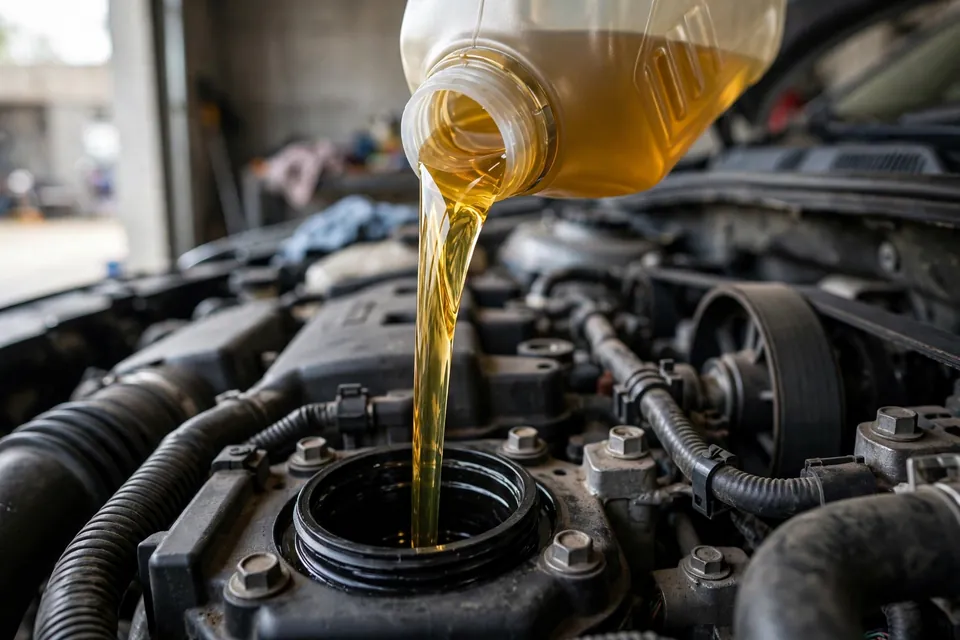
The 3,000-Mile Sticker Is a Lie (And I'm Going to Prove It)
Let me start by saying something that might surprise you: most quick-lube places make money by getting you back more often than you need to come back.
There, I said it. And I've run Delgado Auto Repair in Queens for 14 years, so I know exactly how this business model works. I'm going to tell you the truth that nobody else in this industry wants to admit.
That 3,000-mile sticker they slap in your windshield? It made sense in 1985. It does NOT make sense today. Unless you're driving a classic car with a carbureted engine using straight 30-weight conventional oil, you're probably changing your oil twice as often as you need to.
Let me break down what's actually happening with modern engines and why the old rules don't apply anymore.
Why Oil Changes USED to Be Every 3,000 Miles
Back in the day (we're talking 1970s-1980s):
- Engines had much looser tolerances (metal-to-metal contact, more wear)
- Oil was pure conventional petroleum (broke down faster under heat)
- No synthetic options existed for normal cars
- Engines ran dirtier (worse combustion, more blow-by)
- Oil filters weren't as good (couldn't trap smaller particles)
- Emission controls were primitive or nonexistent
So yeah, 3,000 miles made total sense. Your oil was basically black sludge by then, and your engine needed fresh lubrication.
But that was 40 years ago. Everything has changed.
What's Changed Since Then (Literally Everything)
Modern Engines Are Completely Different
Today's engines are machined to incredibly tight tolerances - we're talking differences measured in microns.
Key improvements:
- Better metallurgy (stronger, more wear-resistant materials)
- Computer-controlled fuel injection (perfect fuel mixture)
- Variable valve timing (optimized efficiency)
- Better piston ring design (less blow-by)
- Improved combustion chamber design (cleaner burning)
- Better PCV systems (manages crankcase pressure)
The result? Modern engines run cleaner, more efficiently, and produce less contamination in the oil.
I've seen modern engines with 200,000+ miles that look nearly new inside because they were maintained properly (not excessively).
Synthetic Oil Is Literally Magic
Seriously, compared to old conventional oil, full synthetic is like comparing a smartphone to a rotary phone. They both do the basic job, but one is VASTLY superior.
Synthetic oil advantages:
- Lasts 2-3 times longer than conventional
- Handles heat better (doesn't break down as fast)
- Flows better in extreme cold (protects on cold starts)
- Keeps engines cleaner (better detergent packages)
- Breaks down much slower (maintains viscosity longer)
- Protects better under stress (towing, racing, hot weather)
- Resists sludge formation
- Better fuel economy (less internal friction)
Is it more expensive up front? Yes - about $25-40 more per change. Does it save you money? Absolutely yes, because you change it half as often.
The math works out in synthetic's favor in just about every case I've run.
Oil Life Monitoring Systems Are Actually Smart
Most cars built after 2010 (and some earlier) have a computer system monitoring your oil condition. It's not just counting miles like a dumb odometer.
Modern systems track:
- Engine temperature cycles (cold starts are hardest on oil)
- Number of cold starts
- RPM ranges (highway vs city driving)
- Load conditions (towing, acceleration)
- Idle time
- Ambient temperature
- Driving patterns (short trips vs long trips)
When your dashboard says "15% oil life remaining," that's actually a pretty accurate calculation based on real-world stress on your oil. It's way better than arbitrary mileage intervals.
I've compared oil-life readings against actual oil condition plenty of times. The computer is usually in the right ballpark — far better than a blind mileage number. That's impressive.
What Your Manual ACTUALLY Says
Here's a radical idea: check your owner's manual.
I know, shocking concept. But that's where the engineers who designed your engine and did thousands of hours of testing tell you what it actually needs.
Most modern cars (2015+) — typical ranges from owner's manuals (always check yours; specs vary by make):
- Conventional oil: 5,000-7,500 miles
- Synthetic blend: 7,500 miles
- Full synthetic: 7,500-10,000 miles
Many newer cars with full synthetic:
- 10,000-15,000 miles between changes
- Some European cars: 15,000+ miles
Yet the quick-lube place puts a sticker saying 3,000 miles.
Why? Because if they can get you back 3 times a year instead of once, that's triple the revenue. It's not conspiracy theory - it's basic business.
The "Severe Service" Loophole (And Why It Probably Applies to You)
Here's where the oil change industry gets tricky. Your manual probably has two maintenance schedules:
- Normal service (longer intervals)
- Severe service (shorter intervals)
Most people think: "I drive a normal commute, so I'm normal service, right?"
Wrong.
Severe service includes:
- Mostly short trips under 10 miles (most commutes)
- Frequent idling (sitting in traffic)
- Stop-and-go traffic (basically all city driving)
- Dusty or dirty conditions (construction zones, dirt roads)
- Towing or hauling (even occasionally)
- Extreme temperatures (below freezing or above 90°F often)
- Track days or spirited driving
Be honest: in my experience, that describes most of my customers' driving.
If you fall under severe service (and you probably do), cut the recommended interval by 30-40%. If your manual says 10,000 miles, do it at 6,000-7,000.
But that's STILL not 3,000 miles.
Synthetic vs. Conventional: Let's Do the Real Math
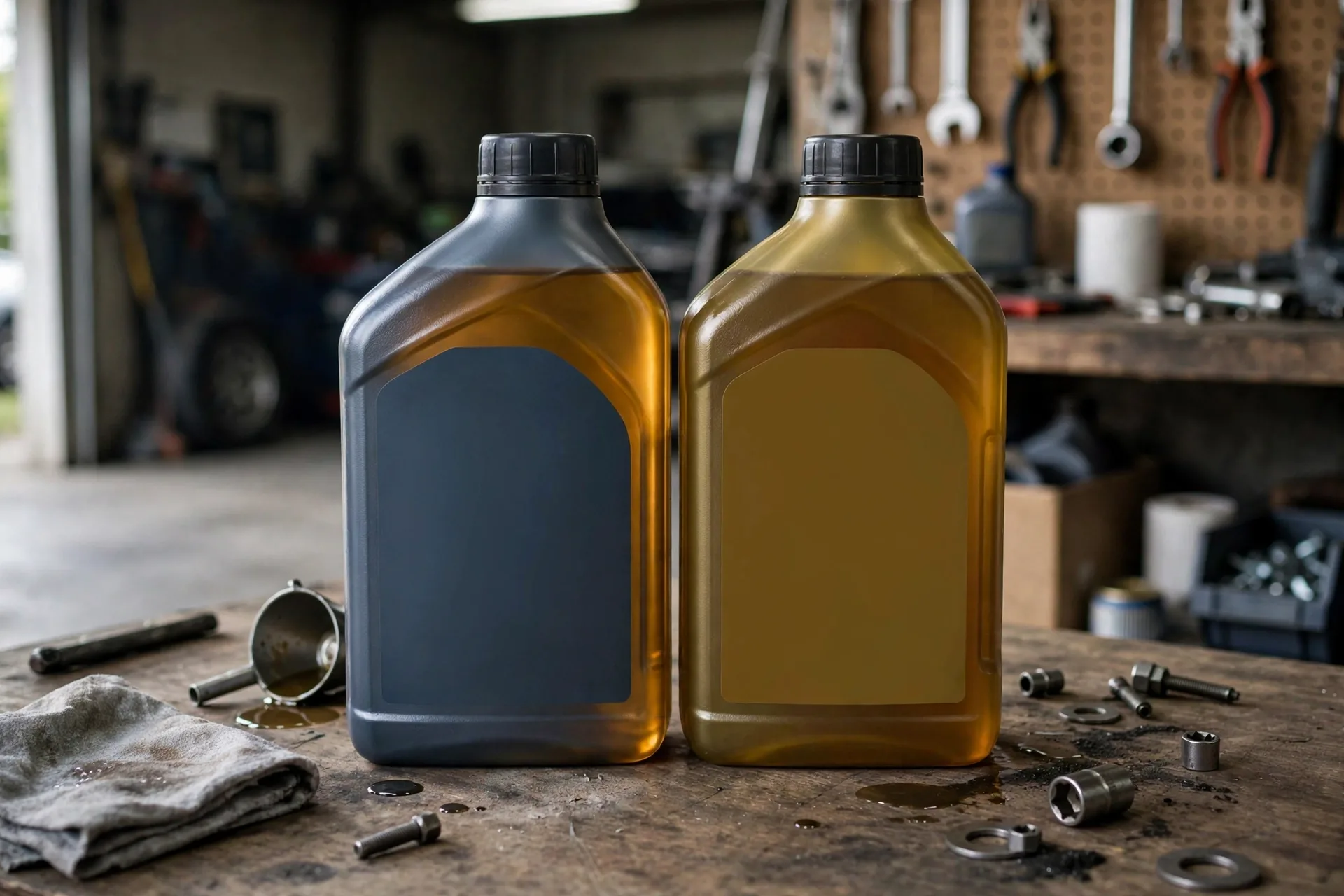 I'm going to show you why synthetic actually saves money over time.
Conventional oil scenario:
- Change interval: 3,000-5,000 miles
- Cost per change: $40-50
- Annual mileage: 15,000 miles
- Changes per year: 3-5
- Annual cost: $120-250
Full synthetic scenario:
- Change interval: 7,500-10,000 miles
- Cost per change: $70-90
- Annual mileage: 15,000 miles
- Changes per year: 1.5-2
- Annual cost: $105-180
You actually SAVE $20-70 per year with synthetic while getting superior protection.
Plus:
- Your engine stays cleaner (extends engine life)
- Better fuel economy (synthetic reduces friction)
- Better cold start protection (less engine wear)
- Better performance in extreme temperatures
It's a no-brainer unless you drive a beater car worth $500 that you're planning to junk soon anyway.
How to Check Your Own Oil (Do This Monthly)
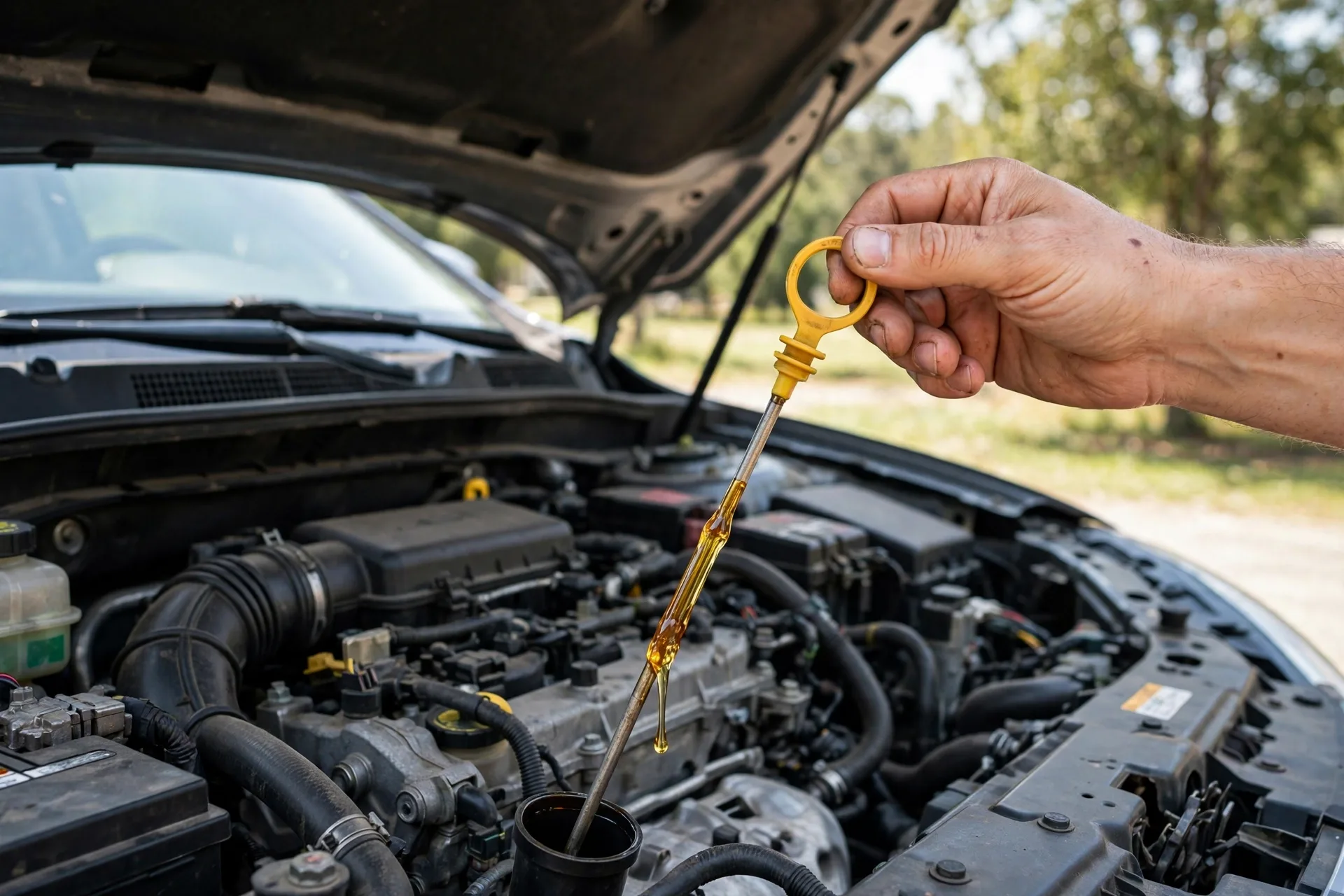 Seriously, check your oil between changes. Takes 2 minutes, costs nothing, can save your engine.
The correct procedure:
- Park on level ground (not on a slope)
- Turn engine off
- Wait 5-10 minutes for oil to drain back to the pan
- Pull out the dipstick (usually has a yellow or orange loop handle)
- Wipe it completely clean with a rag or paper towel
- Push it all the way back in until it seats
- Pull it out again and check the level
What you're looking for:
Level:
- Should be between the MIN and MAX marks (or the crosshatch area)
- If it's at or below MIN, add oil immediately
- If it's above MAX, you have too much (can cause problems)
Color and condition:
- Fresh oil: honey/amber colored, translucent
- Used but good: brown, slightly darker, still translucent
- Needs changing soon: dark brown to black, still slippery
- Bad: Black and thick, or milky (coolant contamination)
Texture:
- Should feel slippery between your fingers
- Should NOT feel gritty (means metal contamination)
- Should NOT look foamy or bubbly
If your oil level drops a quart between changes, you've got a problem:
- Burning oil (common in high-mileage engines)
- External leak (check your driveway for spots)
- Get it checked by a mechanic
Modern engines shouldn't burn oil between changes. If yours does, address it.
Related guide: 2019-2024 RAM 1500 - Check Oil Level — the right way to read a dipstick so you can actually judge your oil's condition.
What Actually Happens If You Go Too Long
I'm not saying you should push your luck, but let me explain the science of what happens as oil ages:
0-5,000 miles: Oil is doing its job perfectly. Additives are fresh, viscosity is good, everything is protected.
5,000-7,500 miles: Oil is still fine. Starting to pick up more contaminants, but modern synthetic handles this easily. This is the sweet spot for changes.
7,500-10,000 miles: Additives are starting to deplete. Oil is darker. Synthetic is definitely degraded but probably still protecting adequately. Change it soon.
10,000-15,000 miles: Oil is significantly degraded. Detergent additives are depleted. You're gambling. If it's full synthetic and you've been highway driving, you're probably okay. If it's conventional or you've been in severe service, you're risking damage.
Beyond 15,000 miles: You're playing with fire. Sludge starts forming, wear accelerates, oil passages can clog. Don't do this.
Way beyond (20,000+): Sludge clogs oil passages. Bearings start failing. Variable valve timing solenoids stick. You're looking at expensive engine damage or complete failure. I've seen engines seize.
Real-world examples I've seen:
- Customer changed oil every 5,000 miles religiously: engine still perfect at 250,000 miles
- Customer "didn't believe in" oil changes, went 30,000 miles: engine seized, $6,000 replacement
- Customer followed manual (10,000 mile synthetic): engine running great at 180,000 miles
The moral? Follow your manual, use good oil, and you'll be fine. Neglect it and you'll pay dearly.
The Filter Matters Just As Much (Don't Cheap Out Here Either)
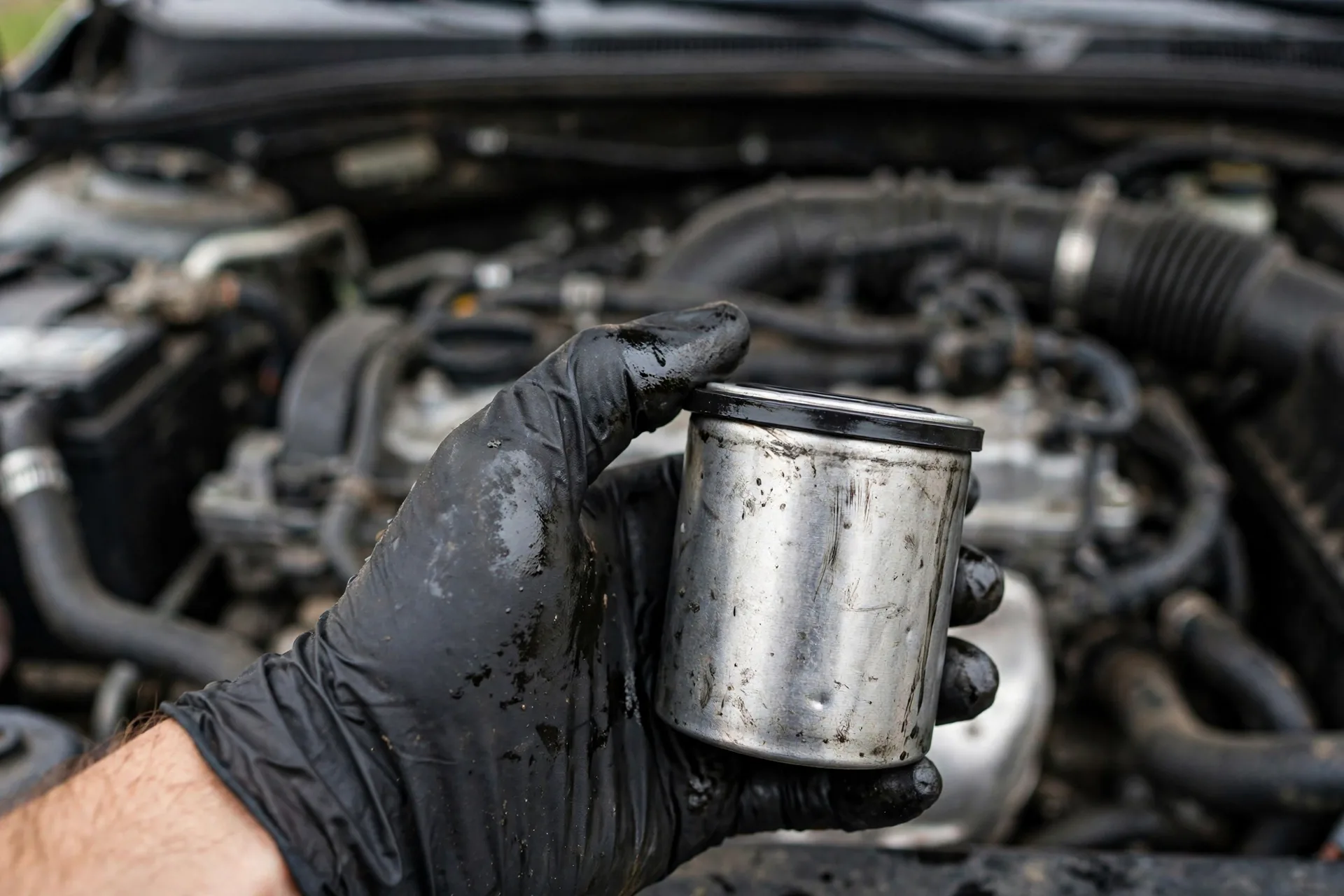 Your oil filter is just as critical as the oil itself. It traps:
- Metal particles from engine wear
- Carbon deposits from combustion
- Dirt and debris that enters the system
- Sludge and varnish
A cheap $3 filter uses cardboard, weak springs, and cheap filtering media. It might last 3,000 miles before it starts bypassing (letting unfiltered oil through).
A quality filter uses synthetic media, strong springs, and better construction. It can handle 10,000+ miles easily.
Oil filter brands I trust (from 14 years of experience):
Top tier:
- Mobil 1 Extended Performance (my go-to)
- K&N (the gold ones, not the cheap ones)
- Royal Purple
- Amsoil
- Wix XP
Solid mid-range:
- Purolator Classic
- Wix (regular line)
- AC Delco (for GM vehicles)
- Motorcraft (for Ford vehicles)
- Bosch
Avoid if possible:
- Fram orange can (notorious for failing early, internal bypass issues)
- SuperTech (Walmart house brand - okay in a pinch)
- Generic no-name filters
- The absolute cheapest option at any store
A quality filter costs $8-15. The cheap one costs $3. That $5-12 difference could save you thousands in engine repairs if a cheap filter fails.
True story: Had a customer use Fram orange filters exclusively. At 80,000 miles, engine started knocking. Tore it down - metal shavings everywhere because the filter media had disintegrated and wasn't filtering anymore. $4,500 engine rebuild.
Don't let that be you.
DIY Oil Changes: Is It Worth Your Time?
If you're comfortable doing it and have a safe way to get under your car, absolutely yes.
Cost breakdown for DIY:
- 5 quarts full synthetic: $25-35 (Costco, Walmart, or on sale)
- Quality filter: $10-15
- Total: $35-50
Shop cost:
- Quick-lube place: $70-90
- Dealer: $90-150
- Independent shop: $70-100
Savings per change: $20-100
What you need:
- Jack and jack stands OR car ramps (never use just a jack)
- Oil drain pan (get a nice one, $20 well spent)
- 14mm or 17mm wrench for drain plug (check your car)
- Oil filter wrench (get an adjustable one, works for any filter)
- Funnel (that doesn't drip all over)
- Rags or shop towels
- Disposable gloves (optional but nice)
- Way to dispose of old oil (any auto parts store takes it free)
Time required: 30-45 minutes once you know what you're doing. First time might take an hour.
Is it worth it? If you change your oil twice a year at $50 savings each time, that's $100/year. Over 10 years with one car, that's $1,000 saved. Multiple cars? Even more.
Plus you KNOW it was done right. You used quality oil and filter. You didn't have some 16-year-old overtighten your drain plug or forget to put oil in (yes, this happens).
The DIY Process (Quick Professional Version)
I've written full detailed guides elsewhere, but here's how I do it after 14 years:
Preparation:
- Buy correct oil (check manual for weight: 0W-20, 5W-30, etc.)
- Buy quality filter for your car
- Warm engine (5-10 minute drive) - warm oil drains faster and more completely
- Park on level ground
Draining:
- Safely raise car (ramps or jack stands - NEVER just a jack)
- Locate oil drain plug on oil pan
- Position drain pan underneath
- Remove drain plug (careful - oil is hot)
- Let drain completely (10-15 minutes for full drain)
- Inspect drain plug washer/gasket - replace if damaged
- Reinstall drain plug - snug, not gorilla-tight (30-35 ft-lbs usually)
Filter:
- Locate oil filter (usually accessible from underneath)
- Position drain pan under filter
- Unscrew old filter (will be messy)
- Clean filter mounting surface on engine
- Prep new filter:
- Fill 1/3 to 1/2 with fresh oil
- Oil the rubber gasket with fresh oil
- Install new filter HAND-TIGHT only (3/4 turn after gasket contacts)
- Never use a wrench to install
Filling:
- Lower car
- Remove oil filler cap on top of engine
- Using funnel, pour in the correct amount (check manual)
- Usually 4-6 quarts, but verify
- Install filler cap
- Start engine, let run 30 seconds
- Shut off, wait 2 minutes
- Check level with dipstick
- Add more if needed (usually need another 1/4 to 1/2 quart)
- Check for leaks around drain plug and filter
- Reset oil life monitor (procedure varies by car)
Disposal:
- Pour old oil into jug or container
- Take to any auto parts store, they recycle for free
- Some cities have hazardous waste collection
- NEVER dump it anywhere
That's it. Not rocket science.
Related guide: 1995-2005 Chevrolet Astro — Oil and Filter Change — fresh oil and a fresh filter in one job — the full DIY walkthrough.
Common Mistakes That Cost People Money
1. Using the Wrong Oil Weight
Your car is engineered for a specific oil weight (viscosity). Using the wrong one can cause:
- Poor fuel economy
- Increased engine wear
- Oil consumption issues
- Check engine lights
- In extreme cases, engine damage
Always use what the manual specifies. The sticker under your hood also shows the correct weight.
Common examples:
- 0W-20 (modern efficient engines)
- 5W-30 (most common, older engines)
- 5W-20 (Ford, Honda, Toyota common spec)
- 0W-40 (some European turbo engines)
Don't use 10W-30 in a car that requires 0W-20 because "thicker is better." You'll cause problems.
2. Mixing Oil Types Without Knowing the Rules
You CAN:
- Mix synthetic and conventional (makes a blend)
- Top off synthetic with conventional in an emergency
- Mix different brands of the same type
You SHOULD NOT:
- Mix weights (5W-30 with 10W-40)
- Use diesel oil in a gas engine (or vice versa)
- Use 2-stroke oil in a 4-stroke engine
For best results, stick with one type and brand. But mixing synthetic and conventional won't blow up your engine.
3. Overtightening the Drain Plug
I've seen people strip oil pan threads because they cranked that drain plug like they were mad at it.
Correct torque: Usually 25-35 ft-lbs depending on the car. That's snug, not Hulk-strength.
If you strip those threads:
- Helicoil repair: $150-300
- New oil pan: $300-800 including labor
- In some cars, you have to drop the subframe to replace the pan: $1,500+
All because you overtightened a $2 drain plug.
Hand-tighten it until it seats, then give it another 1/4 to 1/2 turn with a wrench. That's it.
4. Overtightening the Oil Filter (Or Using a Wrench to Install)
Oil filters go on HAND-TIGHT ONLY. The instructions on the filter say this clearly.
Correct installation:
- Oil the rubber gasket
- Thread it on by hand
- Tighten until the gasket contacts the engine
- Give it another 3/4 turn by hand
- Done
What happens if you wrench-tighten it:
- Crush the gasket (may leak)
- Make it impossible to remove next time
- Crack the filter housing
- Strip the threads on the engine
I've had to cut filters off with a sawzall because someone went wrench-tight on installation. Don't be that person.
5. Not Resetting the Oil Life Monitor
If your car has an oil life monitor and you don't reset it after a change, it'll:
- Show low oil life way before you need the next change
- Confuse you about when service is actually due
- Potentially trigger early warnings
Every car has a different reset procedure. Google "[your car year make model] reset oil life" for exact steps.
Usually involves a combination of key on/off cycles and button presses. Takes 30 seconds.
6. Neglecting the Oil Filter When Changing Oil
Some people (I've seen this) try to just change the oil and reuse the old filter to save $10.
Don't do this. The filter is full of the old dirty oil you just drained, plus it's already collected contaminants. You're putting dirty oil back in your engine.
Always change the filter with the oil. Always.
When to Use Synthetic vs. Conventional vs. Blend
Let me break down when each type makes sense:
Use FULL SYNTHETIC if:
- Your manual requires it (some cars MUST use synthetic)
- You have a turbocharged engine (runs hotter, needs better protection)
- You tow or haul regularly (severe service)
- You want maximum protection and longest intervals
- You live in extreme climates (very hot or very cold)
- You want the best fuel economy
- You can afford the extra $25-30 per change
- You drive a performance car
Use SYNTHETIC BLEND if:
- You're on a budget but want better than conventional
- Your car has higher mileage (100k-150k+)
- You do some severe service driving
- You want to extend conventional intervals slightly
Use CONVENTIONAL if:
- You have an older carbureted engine (pre-1990s)
- Your car is high-mileage and burns oil (cheaper to top off)
- You're changing it every 3,000 miles anyway
- Your car is nearly worthless and you're just keeping it running
- Budget is extremely tight
But honestly? For $20-30 more per change, just use synthetic. Your engine will thank you, and you'll save money long-term through fewer changes.
High-Mileage Oil: Marketing or Actually Useful?
Once you hit 75,000-100,000+ miles, you'll see "high-mileage" oil options. Are they worth it?
What makes them different:
- Seal conditioners (soften dried-out seals)
- More detergents (clean up sludge)
- Different additive packages
- Sometimes slightly higher viscosity
When high-mileage oil helps:
- You're starting to see small oil leaks
- Oil level drops between changes (burning oil)
- Engine has some sludge buildup
- Seals are getting old and stiff
Is it a miracle cure? No. Will it stop a major leak? No. But it can help minor seepage and reduce oil consumption.
If your engine is burning a quart every 1,000 miles, high-mileage oil might reduce that to a quart every 2,000 miles. It buys you time before major repairs.
Worth the extra $5-10? Yes, if you have a high-mileage car showing any symptoms.
Signs You Waited Way Too Long
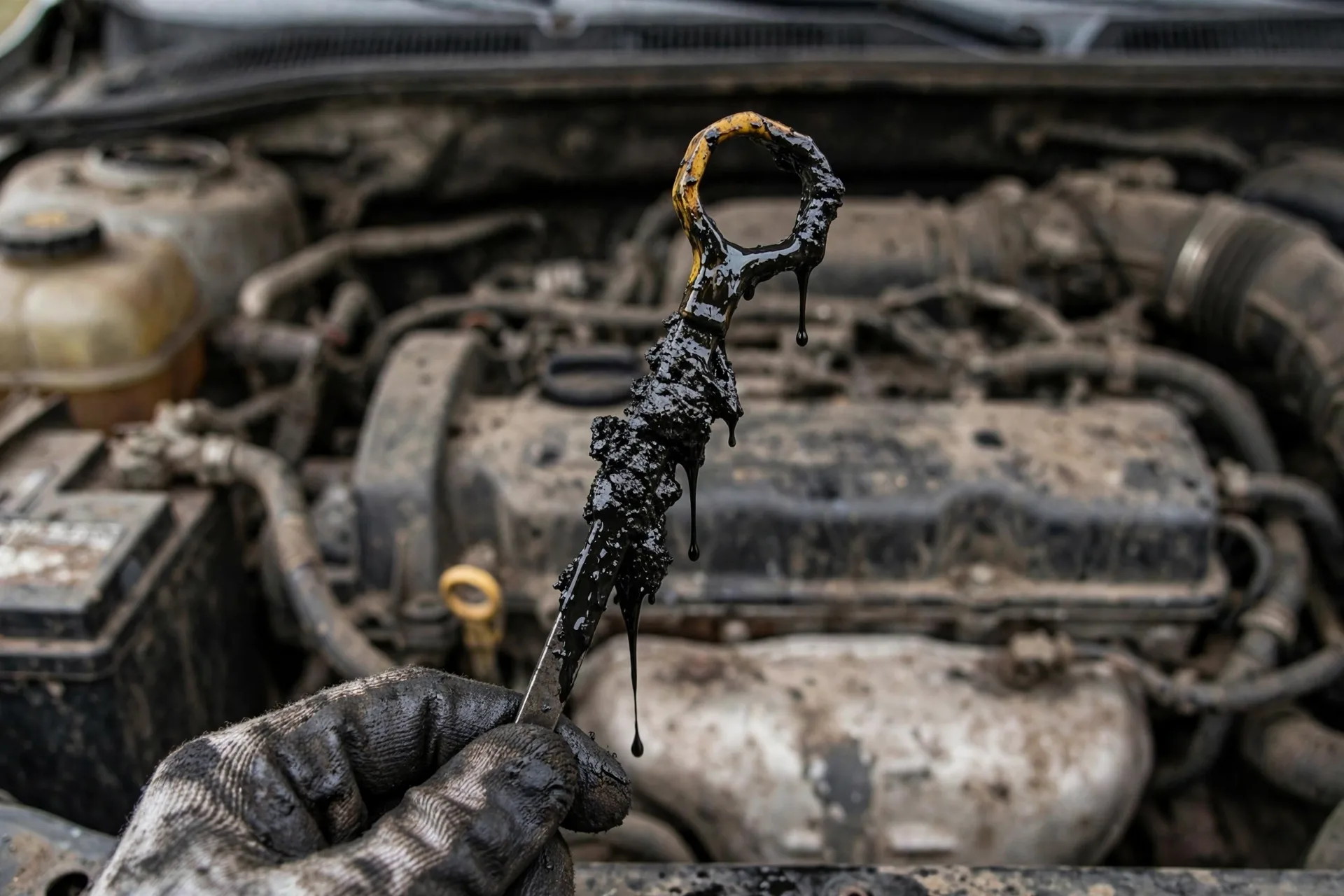 If you see or hear any of these, you've neglected your oil changes and may have caused damage:
Sounds:
- Knocking or ticking noises from engine (bearings not getting lubrication)
- Loud valvetrain noise on cold starts
- Engine sounds rough or "clattery"
Visual signs:
- Check engine light (often oil-related codes: cam timing, VVT)
- Oil pressure warning light (VERY BAD - pull over immediately)
- Visible sludge on dipstick (oil is thick, tar-like)
- Sludge under oil filler cap
- Oil is jet black and smells burnt
Performance:
- Engine runs rough
- Loss of power
- Poor fuel economy
- Hard starting
If you see ANY of these, change your oil IMMEDIATELY and pray you didn't cause permanent damage.
Then get an engine oil flush treatment and change it again in 1,000 miles.
My Professional Recommendations (After 14 Years Running My Shop)
For maximum engine life at minimum cost, do this:
- Use full synthetic oil (best value long-term)
- Follow your manual's recommended interval for severe service (most people)
- Use a quality filter (Mobil 1, K&N, Wix XP)
- Check oil level monthly (takes 2 minutes)
- Keep receipts (helps with resale value, warranty claims)
- Use the correct oil weight per your manual
- Don't exceed 10,000 miles even if manual says you can
My personal schedule:
- Full synthetic 5W-30
- Change every 7,500 miles OR 6 months, whichever comes first
- Mobil 1 Extended Performance filter
- Check level monthly
- Track it in a notebook
This gives maximum protection without wasting money on unnecessary oil changes.
For most people, I recommend:
- Full synthetic oil
- Change every 7,500-8,000 miles
- Or when oil life monitor hits 15-20%
- Whichever comes first
This balances convenience, cost, and protection perfectly.
The Bottom Line: Stop Wasting Your Money
Your engine is the most expensive part of your car - typically $3,000-8,000 to replace. Taking care of it with proper oil changes is the single best thing you can do to make it last.
But you don't need to change it every 3,000 miles. That's outdated advice designed to sell more oil changes.
The truth:
- Modern engines can go 7,500-10,000 miles easily
- Full synthetic lasts much longer than conventional
- Your owner's manual tells you the real interval
- Oil life monitors are surprisingly accurate
- Severe service (city driving) needs more frequent changes
- But even severe service isn't 3,000 miles with synthetic
My final advice:
- Read your owner's manual
- Use full synthetic if you can afford it ($20 more isn't much)
- Change it at the recommended interval, not 3,000 miles
- Use a quality filter
- Check your oil level monthly
- Keep records
Do this and you're giving your engine its best shot at 200,000+ miles without major issues. I've seen well-maintained engines get there hundreds of times.
Questions? Drop them in the comments below. I've done thousands of oil changes in my career and seen every possible scenario.
Stop wasting money. Start doing it right.
- Ray Delgado, ASE Master Technician & Owner, Delgado Auto Repair
Last reviewed: October 2026.