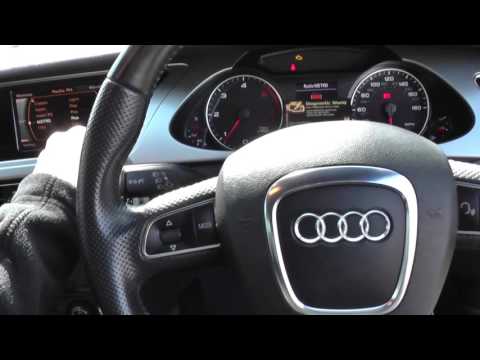
Quick answer: Check Engine Light / OBD2 Diagnosis on a 2019–2024 Audi Q7 is rated Easy and takes about 30–45 minutes. You'll need 2 tools for this job, and parts cost about $25. This guide walks you through the full job step by step, including the mistakes to avoid.
| Part Name |
Part Number |
Price |
Buy |
| OBD2 scanner |
— |
$25.00 |
|
About prices: shown prices are typical retail averages and change frequently; cheaper alternatives may be available. Confirm the current price before buying.
💡 Pro tip: Order all parts at once to save on shipping
Step-by-Step Instructions
Follow these steps carefully
1
Judge the light before driving another mile
Steady amber = stored emissions fault; drive gently to your diagnosis spot. Flashing = active misfire — pull over, shut it down, tow it; sustained misfires cook the converters. Stop at once for a red oil-pressure light, coolant-temperature warning, or a “drive system malfunction” message.
🔧 Mechanic's note — Tom Becker
I've seen too many Q7 owners chase a flashing CEL with a 'one more drive' attitude. A 3.0T misfire under boost can melt a catalytic converter in a single commute — the tow bill is cheap insurance by comparison.
2
Locate the OBD2 port under the dash
Find the 16-pin OBD2 port under the driver-side dash, left of the steering column — the VAG position. Open the door, slide the seat back, and look up with a flashlight; the trapezoidal connector faces down, exposed without trim removal. Push the plug in firmly.
3
Pull codes with a generic scanner
Ignition OFF when you connect; then ON, engine OFF, and select “Read DTCs.” Any generic reader pulls engine codes — no dealer tool needed. Record every code verbatim with status (stored, pending, permanent), and save freeze-frame data: RPM, load, and coolant temperature.
4
Read the families against 3.0T reality
P0300-series: coil packs first, plugs second — single-cylinder misfires under boost usually trace to one tired coil. P0171/P0174 lean: PCV/breather or boost-pipe leak. P00B7: check expansion-tank level and thermostat. P0420: exhaust must be leak-free before blaming the cat. P0440-series: suspect the fuel cap first.
🔧 Mechanic's note — Ray Delgado
My rule: When a misfire code follows the coil to the new cylinder, that's a conviction — stop testing and buy the coil. The 3.0T's coils are identical across all six cylinders, so the swap takes about ten minutes with a basic Torx set.
5
Run the Q7’s quick elimination checks
Reseat the fuel cap; three drive cycles clear EVAP codes. Swap the suspect coil to another cylinder — if the code follows, it's bad. With P00B7, low expansion-tank coolant means thermostat or hose leak. A whistle at the oil cap means a failed PCV diaphragm.
6
Erase only after the fix, then prove it with a drive
Never clear codes mid-diagnosis — you'll destroy freeze-frame data. After the repair, erase the codes, then drive 20–30 minutes of mixed city/highway until monitors complete — the Q7 needs a few warm-up/cool-down cycles. Light off throughout = fixed; same code back = keep testing.
7
Send it to a pro when the basics don’t close the case
Escalate for: flashing CEL; a misfire not following a coil swap (injector or carbon buildup); coolant loss with no puddle (thermostat housing or crossover pipes); P0420 on a sealed exhaust; “drive system malfunction” with reduced power; multiple unrelated codes at once (weak battery or ground).
All Done!
Test your repair before closing everything up. If something doesn't work right, double-check your steps.
⚠️ Common Mistakes to Avoid
- • Replacing the thermostat for a P00B7 without first checking the coolant level — low coolant alone can set it
- • Assuming a P0420-series code means a dead catalytic converter before checking for exhaust leaks upstream of the sensor
- • Clearing codes the night before an emissions test — the monitors will show 'not ready' and the car will fail