Quick answer: Oil and Filter Change on a 2004–2007 Buick Rainier is rated Easy and takes about 30–45 minutes. You'll need 8 tools for this job, and parts cost about $13. This guide walks you through the full job step by step, including the mistakes to avoid.
Oil spec
4.2L inline-six
Capacity 7.0 qt with filter Viscosity 5W-30 (alt: 10W-30)
| Part Name |
Part Number |
Price |
Buy |
| 5W-30 engine oil (6–7 quarts per engine) |
— |
— |
|
| Spin-on oil filter |
— |
$13.00 |
|
| Drain plug washer (if equipped) Optional |
— |
$6.00 |
|
About prices: shown prices are typical retail averages and change frequently; cheaper alternatives may be available. Confirm the current price before buying.
💡 Pro tip: Order all parts at once to save on shipping
Step-by-Step Instructions
Follow these steps carefully
1
Warm the engine and park on level ground
Start the Rainier and let it idle for 2–3 minutes so the oil thins and drains completely; do not get it fully hot. Park on a flat surface, shift into Park, and set the parking brake firmly.
2
Raise the front and locate the drain plug
If you need clearance, lift the front with a floor jack and support it on jack stands placed under the frame rails — never work under a vehicle held only by a jack. Crawl under and find the oil drain plug on the rear-facing side of the oil pan. On the 4.2L inline-six the pan sits just behind the front crossmember; on the 5.3L V8 it is slightly farther back.
🔧 Mechanic's note — Ray Delgado
The Rainier's drain plug hides on the rear-facing side of the pan, just behind the front crossmember — I find it with a light before I even pick up a wrench, so I'm not hunting with oil already on my hands.
3
Remove the oil fill cap and drain the oil
Twist off the oil fill cap on top of the valve cover so air can enter and the oil drains faster. Let the oil drain until it slows to an occasional drip, which takes about 10 minutes.
4
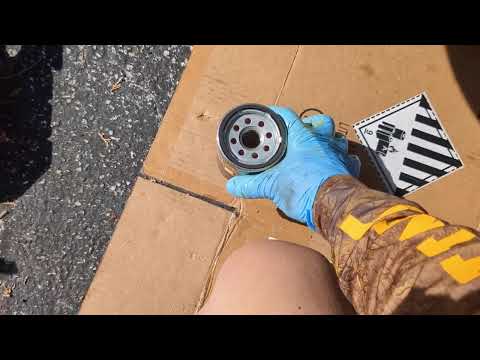
Remove the old oil filter
The spin-on oil filter hangs vertically near the drain plug on both the 4.2L and 5.3L. Loosen it with an oil-filter wrench, then spin it off by hand, keeping it upright so residual oil does not spill.
🔧 Mechanic's note — Ray Delgado
Both Rainier engines hang the filter vertically right by the plug, so I spin it off keeping it upright — tilt it and you'll pour a pint of used oil down your sleeve. I learned that one the sticky way.
5
Install the new filter and drain plug
Smear fresh 5W-30 oil on the new filter's rubber gasket, then thread it on by hand until the gasket contacts the block and tighten an additional three-quarter turn — do not use the wrench to tighten. Inspect the drain plug and its washer, thread it back in by hand to avoid cross-threading, and snug it with the wrench. Do not overtighten the aluminum oil pan threads.
6
Add the correct amount of new oil
The 4.2L inline-six takes 7 quarts of 5W-30; the 5.3L V8 takes 6 quarts — pour in about a half-quart less than capacity through the fill tube using a funnel. Reinstall the fill cap, start the engine for 30 seconds, then shut it off and wait 2 minutes for oil to settle. Pull the dipstick, wipe it, reinsert fully, and check that the level sits at the full mark; top up as needed.
🔧 Mechanic's note — Ray Delgado
I confirm which Rainier engine I'm feeding before I pour — the 4.2L six takes seven quarts, the 5.3L V8 takes six. Pouring a half-quart short and topping up is how I keep from overshooting either one.
7
Check for leaks and reset the oil-life monitor
To reset the oil-life system, turn the key to ON with the engine off and fully press the accelerator pedal three times within five seconds, then verify the 'Change Engine Oil' message clears.
8
Dispose of the used oil properly
Pour the used oil into a sealed container. Take the used oil and old filter to an auto-parts store or recycling center — never pour oil on the ground or into drains. Record the mileage and date.
All Done!
Test your repair before closing everything up. If something doesn't work right, double-check your steps.
⚠️ Common Mistakes to Avoid
- • Forgetting to remove the old filter gasket from the block, which causes a double-gasket leak.
- • Overtightening the drain plug and stripping the oil-pan threads.
- • Adding the wrong capacity — the 4.2L takes 7 quarts while the 5.3L takes 6.