The $50 Sensor That Kills Your Performance
Your car is running rough, hesitating, getting terrible fuel economy. Check engine light is on with codes P0101, P0171, or P0174.
Everyone assumes it's something expensive. O2 sensors? Fuel pump? Catalytic converter?
Often it's just a dirty MAF sensor. Takes 10 minutes and $10 of cleaner to fix.
I can't tell you how many times I've seen people about to spend $500 on parts they don't need, when all they needed was to clean the MAF sensor.
Let me show you what it does, how to diagnose it, and how to fix it for $10.
What the MAF Sensor Does

MAF = Mass Air Flow
Your engine needs the perfect air-to-fuel ratio: 14.7:1
To calculate this, computer needs to know:
- How much air is entering
- How much fuel to add
MAF sensor measures:
- Volume of air flowing into engine
- Air temperature
Computer uses this to:
- Calculate exact fuel needed
- Optimize combustion
- Maximize power and efficiency
When MAF is dirty or failed:
- Computer gets wrong air reading
- Adds wrong amount of fuel
- Engine runs poorly
- Performance suffers
- Fuel economy drops
Where is the MAF Sensor?

Location: Between air filter and throttle body
Usually:
- In the intake tube
- Right after air filter housing
- Before throttle body
Looks like:
- Plastic housing in intake tube
- Electrical connector attached
- Sometimes integrated with intake tube
Easy to spot - follow the intake tube from air filter box
Symptoms of Bad/Dirty MAF Sensor
Check Engine Light - Specific Codes
Common MAF-related codes:
P0101: MAF Circuit Range/Performance P0102: MAF Circuit Low P0103: MAF Circuit High P0104: MAF Circuit Intermittent
Also causes: P0171/P0174: System Too Lean (Bank 1/2) P0172/P0175: System Too Rich (Bank 1/2)
If you see these codes: Check MAF sensor first
Poor Acceleration
Symptoms:
- Hesitation when accelerating
- Flat spots in power delivery
- Takes forever to get up to speed
- Feels sluggish
Why: Computer adding wrong amount of fuel based on bad MAF reading
Rough Idle
Engine idles poorly:
- Surges
- Stumbles
- Inconsistent RPM
- Feels like it wants to stall
MAF telling computer wrong airflow at idle
Stalling
Engine stalls:
- When coming to stop
- When accelerating from stop
- Randomly at idle
Computer adding too little fuel based on bad MAF reading
Poor Fuel Economy
MPG drops significantly:
- Noticeably worse (exact drop varies by vehicle)
- More frequent fill-ups
Computer compensating for bad readings by adding extra fuel
Hard Starting
Cranks longer than normal:
- Takes 5-10 seconds to start
- Used to start immediately
Computer calculating wrong fuel mixture for startup
Black Smoke from Exhaust
Visible black smoke:
- Especially when accelerating
- Running too rich
MAF reading low so computer adds too much fuel
What Causes MAF Sensors to Fail?
Related guide: 2014-2021 Mitsubishi Outlander - PCV Valve Replacement — Oil vapor from a failing PCV valve is a classic cause of fouled MAF sensing wires.
Contamination (Most Common)
Dirt, oil, debris on sensor element:
- From dirty air filter
- Oil from oiled air filters (K&N type)
- Road grime
- General accumulation over time
Even tiny contamination affects sensitive sensor
This is usually fixable with cleaning
Failed Air Filter Maintenance
Dirty or missing air filter:
- Allows contaminants to reach MAF
- Accelerates sensor degradation
- Can permanently damage sensor
Always use quality air filter and replace on schedule
Oiled Air Filters
K&N and similar oiled filters:
- Oil can migrate to MAF sensor
- Coats sensor element
- Causes incorrect readings
If using oiled filter: Don't over-oil it
Age and Wear
Sensors wear out over time:
- Typical lifespan: 100,000-150,000+ miles
- Eventually fail even with good maintenance
Damage
Physical damage:
- Dropped during service
- Improper cleaning
- Manufacturing defect
How to Diagnose MAF Sensor Issues
Check for Codes
Get codes read (free at auto parts stores)
MAF-specific codes (P0101-P0104) = likely MAF issue
Lean/rich codes (P0171-P0175) = could be MAF or other issues
Visual Inspection
Remove MAF sensor, look at element:
Good: Clean, no visible contamination
Bad: Dirt, oil, debris on sensor element
If dirty: Clean it before replacing
Scan Tool Data (Advanced)
With scan tool showing live data:
Watch MAF reading at idle:
- Should be stable
- Typical range: 2-7 g/s (grams per second) depending on engine
Rev engine:
- MAF reading should increase smoothly
- Roughly 100+ g/s at wide open throttle
Bad MAF:
- Reading stuck or erratic
- Doesn't respond to throttle
- Reading way out of range
Unplug Test (Quick Check)
This test works on some cars:
- Start engine (runs poorly)
- Unplug MAF sensor
- Does engine run better?
If yes: MAF is bad/giving wrong reading
If no: MAF probably okay, look elsewhere
Computer runs in default mode without MAF (predetermined fuel map)
Note: Some cars won't run at all without MAF plugged in
Tap Test
With engine running:
- Tap on MAF sensor gently
- Does engine stumble or change?
If yes: Loose connection or failing sensor
How to Clean MAF Sensor

Before replacing: Try cleaning (often fixes the problem)
Difficulty: 2/10 (very easy)
Time: 10-15 minutes
Cost: $10-15 (MAF cleaner)
What You Need
MAF sensor cleaner:
- Specific MAF cleaner (CRC, Gumout, etc.)
- Do NOT use carburetor cleaner or brake cleaner
- Must be electronics-safe
- Must evaporate completely
Tools:
- Screwdriver (to remove sensor)
- That's it
Cleaning Process
Step 1: Remove MAF Sensor
- Disconnect electrical connector
- Remove clamps or screws holding sensor
- Pull sensor out of intake tube
Step 2: Inspect Element
Look inside:
- Should see sensor element (thin wire or hot film)
- Check for contamination
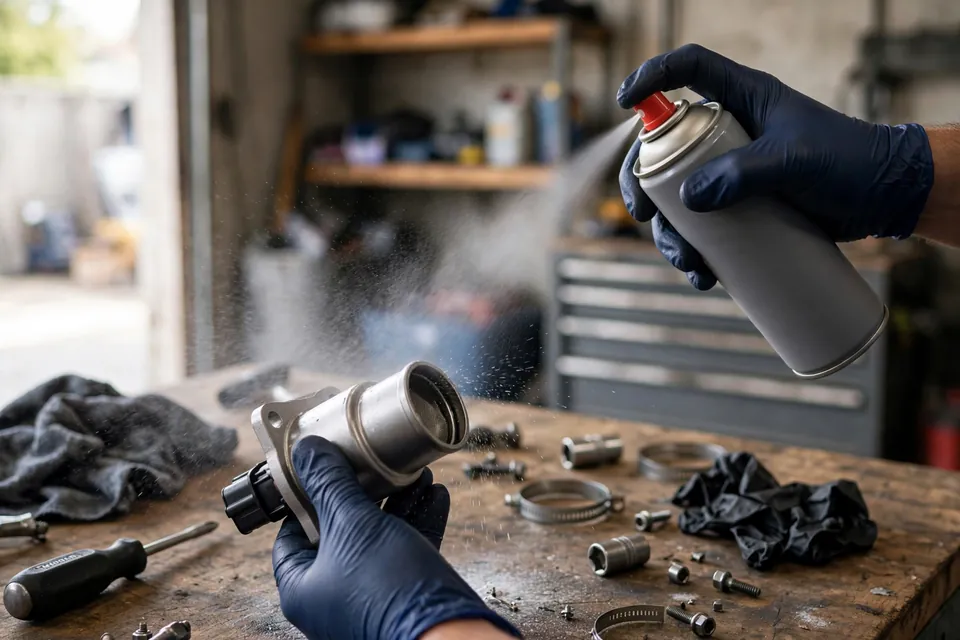
Step 3: Spray with MAF Cleaner
- Spray sensor element generously
- Don't touch element (very delicate)
- Spray from different angles
- Let cleaner drip out
- Repeat 2-3 times
Step 4: Let Dry
- Wait 10-15 minutes
- Cleaner evaporates completely
- Must be completely dry before reinstalling
Step 5: Reinstall
- Put sensor back in intake tube
- Tighten clamps/screws
- Reconnect electrical connector
Step 6: Clear Codes and Test
- Clear check engine light
- Start engine
- Test drive
- Monitor for improvement
Should notice immediate improvement if MAF was the problem
Cleaning Tips
Do:
- Use only MAF-specific cleaner
- Be gentle (sensor is delicate)
- Let dry completely
- Repeat if heavily contaminated
Don't:
- Touch sensor element
- Use compressed air
- Use carb cleaner or brake cleaner
- Use brushes or swabs
- Rush the drying process
When to Replace vs Clean
Try cleaning first:
- Symptoms of dirty MAF
- Sensor looks contaminated
- Costs $10 vs $50-200
- Takes 10 minutes
Replace if:
- Cleaning doesn't help
- Sensor element damaged
- Physical damage visible
- Scan tool shows erratic readings
- Sensor failed electrically (not just dirty)
Give cleaning 2-3 tries before replacing
MAF Sensor Replacement

If cleaning doesn't work:
Difficulty: 2/10 (very easy)
Cost:
- Parts: $50-200 (depends on car)
- Labor: 0.2 hours ($20-40 if shop does it)
Process:
- Disconnect battery (some cars)
- Unplug electrical connector
- Remove clamps/screws
- Remove old sensor
- Install new sensor
- Reconnect everything
- Clear codes
- Test drive
Takes 10-15 minutes
Very easy DIY
Related guide: 2018-2024 Toyota Camry — MAF Sensor Replacement DIY Guide | EZ Car Fix — Vehicle-specific MAF sensor replacement walkthrough if cleaning does not fix it.
Choosing Replacement MAF
OEM (Original Equipment): Best choice
- Highest quality
- Guaranteed fitment
- Most expensive ($150-300)
Quality Aftermarket: Good option
- Bosch, Delphi, Denso
- Much cheaper ($50-150)
- Usually reliable
Cheap no-name: Risky
- Often fail quickly
- Can cause same problems as bad MAF
- Not worth the savings
My recommendation: OEM or quality aftermarket
Other Causes of Similar Symptoms
Before replacing MAF, check:
Vacuum leaks:
- Cause lean codes
- Rough idle
- Poor performance
- Check hoses, intake gaskets
Dirty throttle body:
- Similar symptoms
- Easy to clean
- Often done with MAF cleaning
Bad O2 sensors:
- Also cause lean/rich codes
- Check O2 sensor codes specifically
Clogged fuel filter:
- Hesitation, poor acceleration
- No codes usually
Weak fuel pump:
- Similar symptoms
- But usually hesitation at highway speeds
Dirty fuel injectors:
- Rough idle, poor performance
- Misfire codes often present
Related guide: Kia Sorento - Throttle Body Cleaning — A dirty throttle body mimics MAF symptoms — cleaning it is a cheap next step.
Preventing MAF Sensor Problems
How to keep MAF clean:
1. Replace air filter on schedule
- Every 15,000-30,000 miles
- Or when dirty
- Prevents contamination reaching MAF
2. Use quality air filter
- OEM or quality aftermarket
- Proper filtration protects MAF
3. Be careful with oiled filters
- Don't over-oil
- Oil migrates to MAF
- Consider dry filter instead
4. Check for intake leaks
- Between air filter and MAF
- Allows unfiltered air to contaminate sensor
5. Clean MAF preventively
- Every 30,000-50,000 miles
- Part of tune-up
- Keeps sensor functioning properly
Related guide: 2017-2026 Mazda CX-5 - Engine Air Filter Replacement — A clean air filter keeps debris off the MAF wires in the first place.
The Bottom Line
MAF sensor problems are:
- Common (every car has one)
- Easy to diagnose (specific codes, symptoms)
- Cheap to fix ($10 cleaning or $50-200 replacement)
- Often preventable (air filter maintenance)
Symptoms:
- Check engine light (P0101-P0104, P0171-P0175)
- Poor acceleration
- Rough idle
- Poor fuel economy
- Hard starting
- Stalling
First step: Clean it
- $10 MAF cleaner
- 10 minutes
- Often fixes problem
If cleaning doesn't work: Replace it
- $50-200 parts
- 15 minutes DIY
- Very easy
Prevention:
- Replace air filter on schedule
- Use quality filters
- Clean MAF preventively
- Avoid over-oiling filters
Don't throw parts at problem - diagnose properly
Don't assume expensive - start with $10 cleaning
MAF issues are one of the easiest and cheapest problems to fix.
Questions? Drop them below.
- Ray Delgado, ASE Master Technician
Last reviewed: October 2026.


