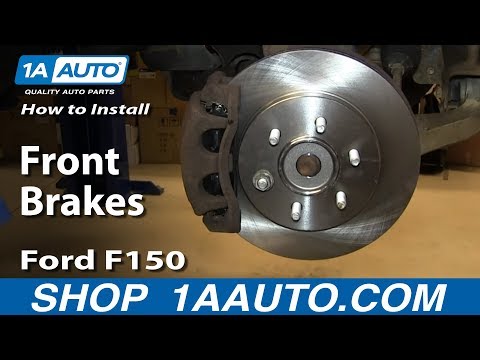
Quick answer: Front Brake Replacement Complete on a 2009–2014 Ford F-150 is rated Moderate and takes about 2-3 hours. You'll need 9 tools for this job, and parts cost about $150. This guide walks you through the full job step by step, including the mistakes to avoid.
| Part Name |
Part Number |
Price |
Buy |
| Front Brake Pads |
TRQ BFA73352 |
$50.00 |
|
| Front Brake Rotors |
TRQ BRA79410 |
$100.00 |
|
About prices: shown prices are typical retail averages and change frequently; cheaper alternatives may be available. Confirm the current price before buying.
💡 Pro tip: Order all parts at once to save on shipping
Step-by-Step Instructions
Follow these steps carefully
1
Loosen lugs and raise the vehicle
The 2009–2014 Ford F-150 has a critical fitment split: 6-lug is standard, but 7-lug wheels exist on heavy-payload models — kits are lug-specific. ALWAYS verify your lug count before ordering. For 6-lug: front rotors are 350mm (13.78 in) vented. Calipers have DUAL phenolic pistons (~2.126 in / 54mm diameter). You'll need: pads, 350mm rotors (if replacing), dual-piston compression tool (pump-style per 1A Auto). Torque: guide-pin bolts 27 ft-lbs, bracket bolts 136 lb-ft (one source says 184 — verify), lug nuts 150 ft-lbs. No electronic wear sensors on most trims (mechanical squealers). The F-150 is a full-size truck — use high-capacity stands. Loosen lugs (150 ft-lbs on reinstall), jack up, support.
🔧 Mechanic's note — Ray Delgado
I loosen the F-150 lugs and I will run them back down in stages, star pattern. I have measured rotor runout caused by nothing but uneven lug torque — the brakes were fine, the tightening was not.
2
Remove the wheel
Remove the front wheel (6-lug or 7-lug — verify). You'll see the dual-piston caliper. The F-150's front brakes are large for truck duty. The 350mm rotor is substantial. The caliper has two phenolic pistons (they're plastic-composite, not metal — don't damage them).
3
Remove the caliper
Remove the caliper guide-pin bolts (27 ft-lbs on reinstall) and slide the caliper off. Support it with wire. If replacing rotors, remove the bracket bolts (136 lb-ft — or 184 per one source; verify for your year). The 350mm rotor should slide off.
4
Remove old pads and hardware
Remove the old pads. They're standard flat pads (ceramic or semi-metallic) with mechanical squealers (no electronic sensors on most trims). The F-150's pads are large. Inspect the 350mm rotor: 34mm nominal, 32mm discard minimum. Clean the bracket. Ensure they move freely. Phenolic pistons can crack if mishandled — be gentle.
5
Compress the piston
Apply even pressure to both phenolic pistons. The pistons should retract smoothly. Phenolic pistons are durable but can be damaged by uneven pressure. Do not cock them. If a piston is seized, the caliper needs replacement.
🔧 Mechanic's note — Tom Becker
I compress the F-150 caliper piston — and if the piston will not budge, I stop and check the parking-brake mechanism instead of forcing it. I have seen a caliper destroyed by forcing, and the pause is always cheaper.
6
Clean and install hardware
Clean the bracket thoroughly. Install new hardware. Install the new pads — ensure they slide freely. The dual-piston caliper needs pads that sit flat against both pistons.
7
Install new pads and caliper
Reinstall the guide-pin bolts (27 ft-lbs). If you removed the bracket, reinstall it (136 lb-ft or 184 — verify). Pump the pedal to seat the pads. The F-150's large system takes a few pumps. Check the phenolic pistons extended evenly.
8
Refit wheel and pump the pedal
Reinstall the wheel and torque lug nuts to 150 ft-lbs in a star pattern. Lower the F-150. Pump until firm. Test drive: verify no pulling, firm pedal. The F-150 should stop confidently. Check for leaks.
All Done!
Test your repair before closing everything up. If something doesn't work right, double-check your steps.
⚠️ Common Mistakes to Avoid
- • Not properly securing the vehicle with jack stands before starting the repair.
- • Failing to clean the rotor surface before installing new pads, leading to uneven braking.
- • Over-tightening caliper bolts, which can damage components and affect braking performance.