Quick answer: Mass Airflow Sensor Cleaning on a 2009–2014 Nissan Maxima is rated Easy and takes about 30 minutes. You'll need 6 tools for this job, and parts cost about $10. This guide walks you through the full job step by step, including the mistakes to avoid.
| Part Name |
Part Number |
Price |
Buy |
| Mass Air Flow Sensor Cleaner |
CRC-05110 |
$10.00 |
|
| Replacement Mass Air Flow Sensor (if needed) Optional |
22680-7S00A |
$150.00 |
|
About prices: shown prices are typical retail averages and change frequently; cheaper alternatives may be available. Confirm the current price before buying.
💡 Pro tip: Order all parts at once to save on shipping
Step-by-Step Instructions
Follow these steps carefully
1
Cool the engine and locate the MAF
With the 2009-2014 Nissan Maxima engine off and cool, open the hood and find the mass airflow sensor in the intake tube between the air filter box and the throttle body — it is the small module with an electrical connector plugged into the side of the intake duct, held by two screws. On this generation's VQ35DE the MAF sits in the accordion-style intake hose just downstream of the airbox, easy to reach from the top. Wear gloves and eye protection. Confirm the symptoms fit a dirty MAF before you start: rough or hunting idle, hesitation on tip-in, stalling at stops, poor fuel economy, and P0101/P0171 codes are the classic pattern.
🔧 Mechanic's note — Tom Becker
I locate the Maxima MAF and I note the connector — on reinstall it clicks home and gets a tug. I have chased a lean code for an hour that was just a MAF connector not fully seated, and I check it first now.
2
Disconnect the connector and remove the sensor
Unplug the MAF electrical connector on the 2009-2014 Nissan Maxima by pressing its locking tab — pull the connector body, never the wires. Remove the two screws holding the sensor into the intake tube (they are usually small Phillips or security-Torx; have both drivers ready). Lift the sensor straight out. Do not drop it and do not touch the sensing element with your fingers — the hot-wire/film element is a fragile platinum wire that skin oil will coat and ruin. If the whole meter section unbolts from the tube, you can clean it on the bench, which is easier.
3
Clean with MAF cleaner only
Hold the sensor with the element facing down and spray mass-air-flow sensor cleaner liberally across the hot-wire/film element and the inside of the housing — 10 to 15 short bursts, letting the solvent carry the contamination off. Never use carb cleaner, brake cleaner, or any brush or cotton swab on the 2009-2014 Nissan Maxima MAF element: those chemicals leave residues that insulate the wire, and anything touching it can break it. Let the sensor air-dry completely for at least 10 minutes; do not use compressed air, which can snap the wire. The element should look clean and shiny when done.
4
Inspect the air filter and ducting
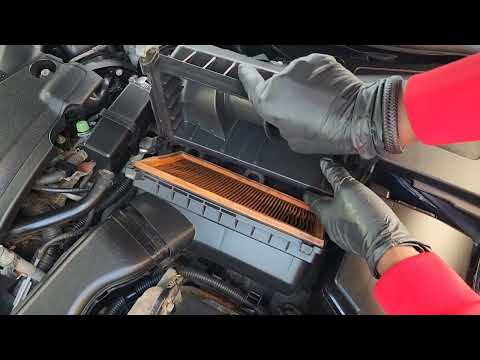
While the MAF is out, check the 2009-2014 Nissan Maxima engine air filter — a filthy filter is what contaminated the sensor in the first place, and cleaning the MAF without replacing a dirty filter just restarts the cycle. Inspect the accordion intake duct for cracks and the clamps for looseness; on this generation the duct develops hairline cracks that leak unmetered air and mimic a bad MAF. Also check the PCV hose for excess oil — oil mist from a failing PCV valve coats the element faster than normal. Replace the air filter if it is gray and clogged.
🔧 Mechanic's note — Tom Becker
I inspect the Maxima air filter and ducting — after the MAF service I park it over cardboard overnight. I have seen seeps that only show after sitting, and the cardboard tells me the truth by morning.
5
Reinstall the MAF and reconnect
Refit the dry MAF sensor into the 2009-2014 Nissan Maxima intake tube, tightening the two screws evenly — snug is enough, since the housing is plastic and the screws strip easily. Reconnect the electrical plug until it clicks and tug it gently to confirm. Double-check that the intake duct clamps are tight and there are no vacuum leaks at the tube joints; unmetered air downstream of the MAF causes the exact lean codes you are trying to fix. Make sure no tools or rags are left in the engine bay.
6
Start, clear codes, and verify drivability
Start the 2009-2014 Nissan Maxima and confirm a smooth, steady idle — the idle may hunt for a minute while the ECM relearns, which is normal after a MAF cleaning.
🔧 Mechanic's note — Tom Becker
I start the Maxima, clear codes, and drive it after a MAF cleaning — the computer needs real airflow to relearn, and I watch for smooth acceleration and no hesitation. A clean sensor changes how the whole car drives.
All Done!
Test your repair before closing everything up. If something doesn't work right, double-check your steps.
⚠️ Common Mistakes to Avoid
- • Using non-recommended cleaning agents that can damage the sensor
- • Touching the sensor's delicate components with bare hands, leading to contamination
- • Not allowing the sensor to dry completely before reinstalling, causing electrical issues