The Clicking That Means $400 Repair Coming
You're turning into a parking spot. Click-click-click-click. Sounds like a playing card in bicycle spokes.
That's your CV joint failing.
Ignore it and:
- Clicking gets louder
- Becomes constant
- Axle breaks while driving
- You're stranded
- Possibly causes more damage
CV axle replacement costs $300-500 per side. If the axle breaks completely, you might need towing ($100-200) plus potential damage to transmission or other parts.
I see people drive around for months with clicking CV joints. "It's not that bad yet." Then one day the axle breaks on the highway and now it's a bigger problem.
Let me show you what causes this, how to diagnose which side is bad, and when you need to fix it.
What CV Axles and Joints Do
CV = Constant Velocity
On front-wheel-drive and AWD vehicles:
- Engine power goes to transmission
- Transmission sends power to front wheels
- CV axles transfer power while allowing wheels to move up/down and turn
Each front axle has two CV joints:
Inner CV joint (near transmission):
- Allows up/down movement (suspension travel)
- Plunging joint (slides in and out)
- Usually tripod or tulip design
Outer CV joint (at wheel):
- Allows steering angle
- Ball-type joint
- Where most failures occur
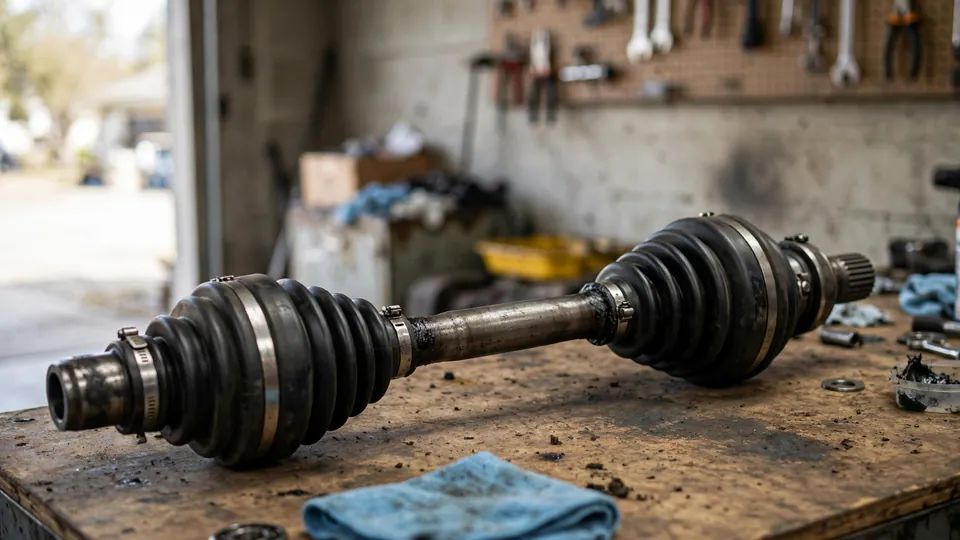
Boot covers each joint:
- Rubber or silicone cover
- Keeps grease in
- Keeps dirt and water out
When boot tears:
- Grease slings out
- Dirt and water get in
- Joint wears rapidly
- Eventually fails
Symptoms of Bad CV Axle/Joint
Clicking Noise When Turning
The classic symptom:
- Click-click-click when turning
- Louder when turning sharply
- Worse when accelerating in turn
- Outer CV joint is worn
Left turn = right CV joint (more weight on right wheel)
Right turn = left CV joint (more weight on left wheel)
This is THE diagnostic symptom - clicking in turns means bad CV joint
Torn or Damaged Boot
Visual inspection shows:
- Torn rubber boot
- Grease on inside of wheel
- Grease slung around suspension area
Even small tear = problem coming
Catch it early (just torn boot) = $100-200 boot replacement
Wait until joint clicks = $300-500 axle replacement
Clunking When Accelerating
Loud clunk:
- When taking off from stop
- When shifting (manual transmission)
- Inner CV joint worn
Or could be:
- Engine mount
- Transmission mount
- But CV joint is common
Vibration at Highway Speeds
Vibration that increases with speed:
- Bent axle shaft
- Damaged joint
- Unbalanced shaft
Could also be:
- Wheel balance
- Tire issue
- Wheel bearing
But worth checking CV axles
Grease on Inside of Wheel
After driving, look at inside of wheel:
- Grease slung everywhere
- Boot is torn
- Joint is being damaged
Fix before joint fails
Shuddering During Acceleration
Vibration/shudder when accelerating:
- Especially from stop
- Inner CV joint worn
- Or outer joint severely worn
How CV Joints Fail
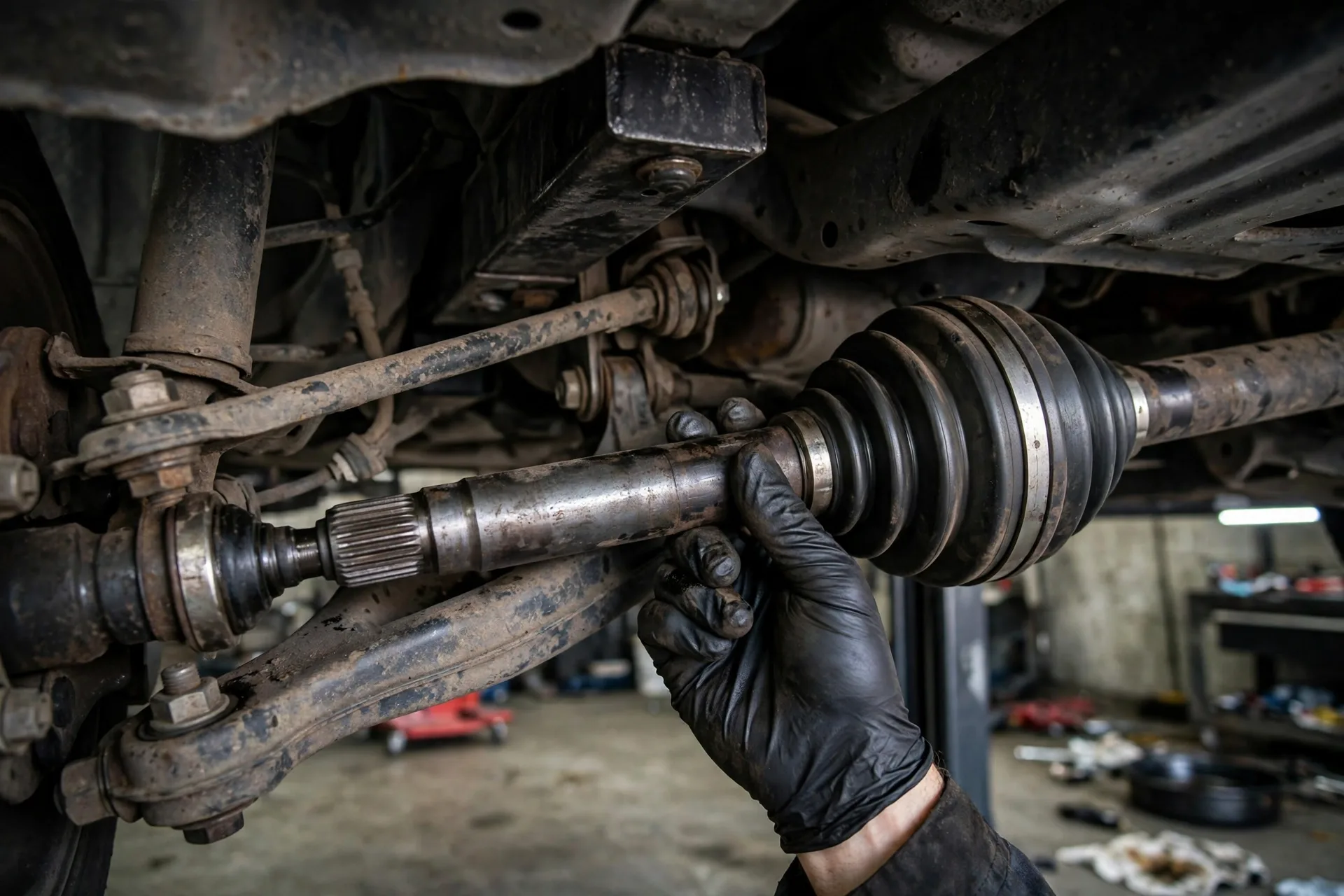
Torn Boot (Most Common Cause)
CV boot tears from:
- Age (rubber cracks)
- Contact with road debris
- Rubbing on other parts
- Chemical damage (oil, road salt)
Once torn:
- Grease slings out
- Dirt and water enter
- Joint loses lubrication
- Metal-on-metal wear accelerates
- Joint fails (clicking, then breaks)
Time from torn boot to failure: Varies
- Can be weeks (if driven in dirt/water)
- Can be months (if highway driving)
- Can be a year+ (if caught very early)
But it's progressive - won't heal itself
Normal Wear (High Mileage)
CV joints are wear items:
- Typical lifespan: 100,000-200,000+ miles
- Eventually wear out even with intact boots
Especially if:
- Lots of tight turning
- Heavy acceleration
- Rough roads
- Towing
Damage from Impact
Hitting potholes, curbs:
- Can bend axle shaft
- Can damage joint
- Can tear boot
One big impact can start the failure process
Contamination
If boot is torn:
- Water enters joint
- Causes rust
- Accelerates wear
Road salt especially damaging
Diagnosing Which CV Axle is Bad
Related guide: 2020-2024 Subaru Outback - Front Wheel Bearing Replacement — A failing wheel bearing makes a similar noise — rule it out before condemning the axle.
The Turn Test (Best Method)
While driving:
- Drive at low speed (parking lot)
- Turn steering wheel full left
- Accelerate gently in circle
- Listen for clicking
- Repeat turning right
Clicking when turning left = RIGHT axle bad
Clicking when turning right = LEFT axle bad
Why opposite? Weight transfers to outside wheel during turn, loading that joint more
Visual Inspection
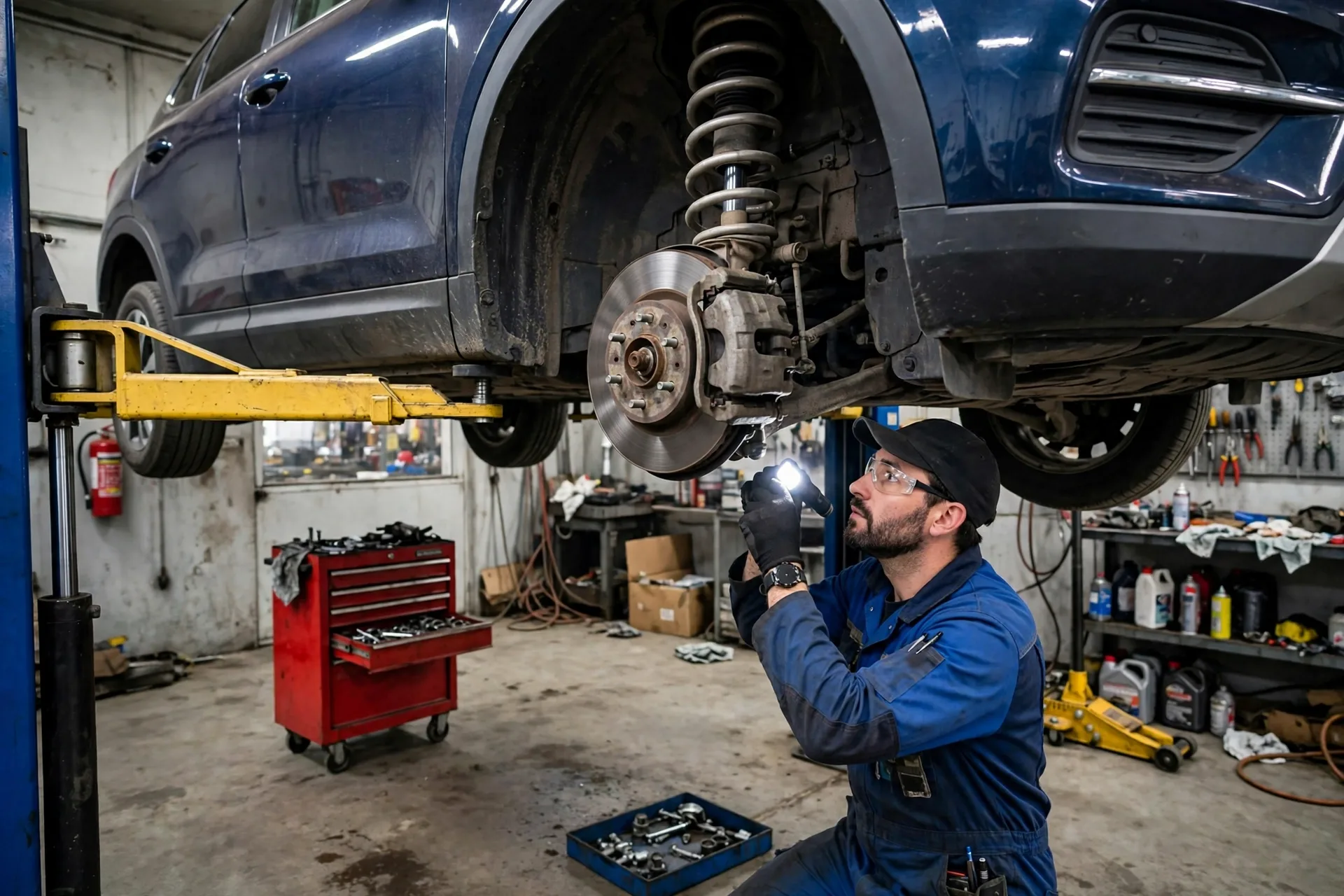
Jack up front of car safely:
- Look at both CV boots
- Check for tears, cracks
- Look for grease slung around
- Grab axle shaft, try to move it (shouldn't move much)
Torn boot on one side = that side is problem
Grease Location Test
Look at inside of wheels:
- Grease on left wheel = left axle leaking
- Grease on right wheel = right axle leaking
- Grease on both = both leaking (common)
Spin Test (Advanced)
Car jacked up safely:
- Put transmission in neutral
- Spin wheel by hand
- Listen and feel for roughness
- Compare both sides
Rough, grinding feeling = worn joint
CV Axle Replacement Process

Difficulty: 6/10 (moderate, but doable)
Time: 2-3 hours per side (first time)
Tools needed:
- Large socket or axle nut socket (30-36mm usually)
- Impact wrench (helpful but not required)
- Ball joint separator or pickle fork
- Pry bar
- Jack and jack stands
- Basic hand tools
- Torque wrench
Related guide: Subaru Forester - CV Axle Replacement — Step-by-step CV axle replacement walkthrough.
General Process
Note: Varies by vehicle, this is general procedure
- Loosen axle nut (with wheel on ground)
- Lift and support car
- Remove wheel
- Remove axle nut completely
- Disconnect sway bar link (if needed)
- Disconnect lower ball joint (or control arm)
- Pull steering knuckle outward (compresses CV joint)
- Remove outer CV joint from hub
- Pry inner CV joint from transmission (or unbolt)
- Remove old axle
- Install new axle (reverse process)
- Torque axle nut to spec (usually 150-200+ ft-lbs)
- Reinstall everything
- Check transmission fluid (some drains when axle removed)
Challenges
Axle nut is VERY tight:
- 150-250 ft-lbs usually
- Requires breaker bar or impact wrench
- Some need to be loosened with wheel on ground (leverage)
Getting inner joint out of transmission:
- Can be stuck
- Requires prying carefully
- Don't damage transmission seal
Getting outer joint out of hub:
- Can be stuck from rust
- Might need to tap it out
- Don't damage hub bearing
Transmission fluid leaking:
- When axle removed, trans is open
- Work quickly
- Have fluid ready to refill
New vs. Remanufactured Axles
New OEM axles:
- Best quality
- Most expensive ($200-400 each)
- Guaranteed fit and quality
Remanufactured axles:
- Rebuilt with new joints and boots
- Mid-price ($80-200)
- Quality varies by brand
Cheap new aftermarket:
- $50-100
- Often fail quickly
- Not worth the savings
My recommendation: Quality remans from good brands (Cardone, A1 Cardone, GSP) or OEM
Cost Breakdown
Parts (per axle):
- Budget remans: $60-120
- Quality remans: $100-200
- OEM new: $200-400
Labor (per axle):
- 1.5-2.5 hours typically
- $150-300 labor
Total per axle:
- DIY: $100-200 (quality reman)
- Shop: $300-500 (parts + labor)
Both axles:
- DIY: $200-400
- Shop: $600-1,000
More expensive on:
- AWD (more complex)
- Some luxury vehicles
- Tight engine bays
Boot Replacement vs. Axle Replacement
If boot JUST tore and you catch it immediately:
Can replace just boot:
- Cost: $30-60 per boot
- Labor: $100-200
- Total: $130-260 per side
But only if:
- Boot just tore
- No clicking yet
- Joint still smooth
- Grease still present
Process:
- Remove axle
- Replace boot
- Repack with grease
- Reinstall
If clicking has started: Too late, joint is damaged, need full axle
Most mechanics don't offer boot replacement - labor is similar to axle replacement, and axle includes new joints and boots
Can You Drive With Bad CV Axle?
If just clicking:
Short term: Yes, but not recommended
- Clicking will get worse
- Will eventually break
- Plan for failure
How long: Varies widely
- Could be weeks
- Could be months
- Unpredictable
Risks:
- Axle breaks while driving (loss of power to that wheel)
- Stranded (need tow)
- Possible damage to transmission seal
- Possible damage to wheel bearing
Don't plan long trips with clicking CV joint
If axle is broken:
No. That wheel has no power, car won't move (FWD) or will limp badly (AWD)
Preventing CV Axle Failure
How to extend life:
1. Inspect boots regularly
- Every oil change
- Look for tears or cracks
- Catch tears early
2. Fix torn boots immediately
- Before joint is damaged
- Much cheaper than axle
3. Avoid aggressive turning
- Don't turn wheels fully when accelerating hard
- Stresses outer CV joints
4. Don't hold wheels at full lock
- When parked or stuck
- Puts maximum stress on joint
5. Avoid potholes and curbs
- Impact damage bends axles and tears boots
6. Keep suspension in good shape
- Worn suspension puts extra stress on axles
Rear CV Axles (AWD/RWD)
AWD vehicles also have rear CV axles:
- Similar symptoms
- Similar failure modes
- Similar replacement process
- Sometimes called half-shafts
Independent rear suspension uses CV axles
Check rear axles if you have AWD and hear clicking from rear
Inner vs. Outer CV Joint Failure
Outer joint (more common):
- Clicking when turning
- Grease visible on wheel
- Boot on wheel side torn
Inner joint (less common):
- Clunking on acceleration
- Vibration
- Boot on transmission side torn
Often both joints on one axle fail around same time if boot has been torn for a while
Replacing axle replaces both joints
When to Replace Both Sides
If one axle failed:
Other side likely has similar wear:
- Same age
- Same mileage
- Same conditions
Consider replacing both if:
- Over 150,000 miles
- Both boots show wear
- Other side clicking slightly
- Don't want to do job twice
Pros of doing both:
- Save on labor (do both at once)
- Won't need repeat work soon
- Matching new axles
Cons:
- More expensive up front
- Maybe other side has life left
My take: If over 150k or other side shows wear, do both
The Bottom Line
CV axle problems are:
- Common on FWD/AWD vehicles
- Progressive (gets worse over time)
- Preventable (catch torn boots early)
- Moderate DIY (doable with tools and skill)
Classic symptom:
- Clicking when turning
- Louder in sharp turns
- Worse with acceleration
Diagnosis:
- Turn test (which side clicks)
- Visual boot inspection
- Grease on wheels
Cost to fix:
- DIY: $100-200 per axle (quality reman)
- Shop: $300-500 per axle
- Both sides: $600-1,000 at shop
Prevention:
- Inspect boots regularly
- Fix tears immediately ($130-260)
- Avoid aggressive turning
- Don't ignore clicking
Timeline:
- Just torn boot: Fix now ($130-260)
- Light clicking: Fix within month ($300-500)
- Loud clicking: Fix this week
- Broke: Get towed ($$$)
Don't ignore clicking - that $300 repair becomes $500+ with towing when axle breaks.
Questions? Drop them below.
- Roberto Gil
Last reviewed: October 2026.