Quick answer: Wiper Blade Replacement on a 2001–2006 Dodge Stratus is rated Easy and takes about 10–20 minutes. You'll need 1 tool for this job, and parts cost about $66. This guide walks you through the full job step by step, including the mistakes to avoid.
| Part Name |
Part Number |
Price |
Buy |
| Driver wiper blade, 22" |
Bosch 22A |
$32.99 |
|
| Passenger wiper blade, 22" |
Bosch 22B |
$32.99 |
|
About prices: shown prices are typical retail averages and change frequently; cheaper alternatives may be available. Confirm the current price before buying.
💡 Pro tip: Order all parts at once to save on shipping
Step-by-Step Instructions
Follow these steps carefully
1
Confirm the correct blade sizes — sedan vs coupe
Sedan: 22-inch driver and 22-inch passenger, per the Mopar guide. The Stratus is the Sebring sedan's mechanical twin, so sizes match. The coupe (2001-2005) differs: 24-inch driver, 21-inch passenger. No rear wiper on any Stratus.
2
Check the 9x3 J-hook arms
Both front positions use a small 9 x 3 mm J-hook arm. Check the hooks visually; bent or corroded hooks make a new blade sit crooked. Any 9x3-hook blade fits, and the two 22-inch blades are interchangeable.
3
Lift the arms — no service position needed
No service position needed; the arms lift straight up, ignition off. Old Stratus arms have strong springs, so keep a firm grip with a folded towel on the glass under the arm. Work one side at a time.
4
Slide the old blade out of the hook
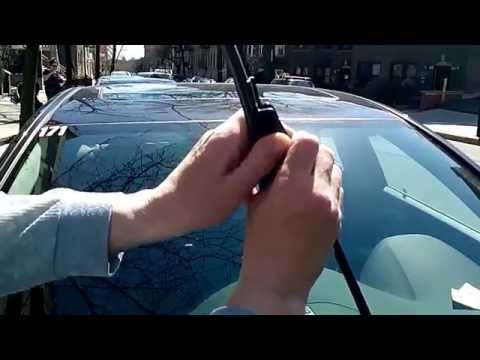
Rotate the old blade perpendicular to the arm, release the locking tab, and slide the blade out. A seized adapter gets a gentle side-to-side wiggle, never a yank on the arm. Note the adapter's orientation before removing it.
5
Fit the new 22-inch blades and latch them
Thread each new 22-inch blade through its hook until the tab clicks, then tug toward the arm tip; an unlatched blade slides out on the first wipe. Peel the protective strips and lower the arms gently, towel in place.
6
Check blade symmetry before lowering the arms
Identical 22-inch blades hide an off-center adapter, and the blades then collide mid-windshield. Before lowering the second arm, check each adapter sits at the same depth in its hook and each blade lies flat on the glass.
🔧 Mechanic's note — Tom Becker
I've learned that that symmetry check is the step everyone skips — and it's why Stratus blades clack together at the center of the windshield. Ten seconds comparing both adapters in their hooks beats pulling everything apart again.
7
Test the wipe and check for arm-spring wear
Run the washers with towels removed; both blades should sweep smoothly. Contact at the center means an adapter is off-center. Bouncing at speed usually means weak arm springs on a Stratus this age, not bad blades.
🔧 Mechanic's note — Ray Delgado
Bouncing or a missed band at speed after new blades almost always means tired arm springs on these cars, not a blade problem. New rubber can't fix a spring that won't hold pressure — I check the arms before buying a second set of blades.
All Done!
Test your repair before closing everything up. If something doesn't work right, double-check your steps.
⚠️ Common Mistakes to Avoid
- • Ordering coupe-sized blades (24/21) for a sedan — like the Sebring, the Stratus coupe is a different car with different sizes.
- • Reusing a cracked universal adapter — at this age the old adapter's locking tab is often brittle and will not hold the new blade.
- • Installing both 22-inch blades without checking centering — an off-center adapter makes the blades collide at mid-windshield.