Quick answer: AC Not Blowing Cold / Recharge on a 2019–2024 RAM 1500 is rated Moderate and takes about 30-60 minutes. You'll need 2 tools for this job, and parts cost about $45. This guide walks you through the full job step by step, including the mistakes to avoid.
| Part Name |
Part Number |
Price |
Buy |
| Correct refrigerant DIY kit with gauge (R-134a or R-1234yf as labeled) |
— |
$45.00 |
|
| AC leak detect dye (optional) Optional |
— |
$12.00 |
|
About prices: shown prices are typical retail averages and change frequently; cheaper alternatives may be available. Confirm the current price before buying.
💡 Pro tip: Order all parts at once to save on shipping
Step-by-Step Instructions
Follow these steps carefully
1
Confirm refrigerant type and symptoms
Read the under-hood A/C label (SAE J639) — it names the refrigerant and charge weight. The 2019+ Ram 1500 (DT) uses R-1234yf with PAG 46-H oil, so buy an R-1234yf kit: R-134a fittings won't fit. Confirm warm vents on MAX A/C with recirc, and check the cabin filter behind the glove box — weak airflow mimics low charge.
🔧 Mechanic's note — Tom Becker
Don't listen for a clutch click on these Rams — the variable-displacement compressor has none. I watch the pulley instead: steady rotation means it's engaged and working.
2
Prep and find the low-side port
Engine OFF. The low-side port sits on the larger suction line from the firewall evaporator to the compressor — follow it to the cap marked 'L'. The DIY hose clicks only onto that coupler; if it won't click, stop (wrong port or refrigerant family). Never force it or use adapters, and never touch the high-side 'H' cap.
3
Baseline pressure with A/C on
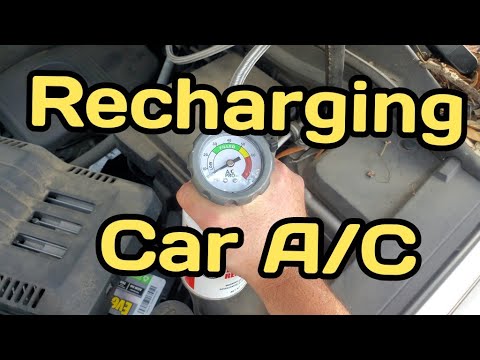
Start the engine: MAX A/C, coldest setting, recirc ON, blower on high. After 2-3 minutes, connect the gauge to the low-side port and compare against your kit's ambient-temperature chart. Near zero? Stop — an empty system needs professional evacuation, leak repair, and recharge by weight; a top-off won't fix it and liquid slugging can destroy the compressor.
🔧 Mechanic's note — Ray Delgado
In my experience, A gauge sitting near zero is telling you the system is open to air, not just low. Topping it off without evacuation lets moisture in, and moisture eats the compressor from the inside out.
4
Add refrigerant in short bursts
With the system running, add refrigerant in 5-10 second bursts with the can upright — vapor only, never inverted; liquid reaching the compressor can destroy it. Pause and re-check the gauge and vent temperature between bursts, aiming for the middle of the chart: overcharging raises head pressure and hurts cooling. R-1234yf is mildly flammable (ASHRAE A2L) — no flames, no smoking, ventilate. Never vent refrigerant; recovery needs EPA Section 609 equipment. Skip stop-leak cans: sealants clog the expansion valve or orifice tube.
5
Stop criteria and wrap-up
Stop when low-side pressure matches the ambient chart and center vents blow cold (high-30s to mid-40s F on MAX). Disconnect the hose and firmly reinstall the 'L' cap — it's the primary seal — then recheck cooling after a short drive. Cooling fades within days? You have a leak: get a UV-dye inspection or shop leak-down test, not another can. Repeated top-offs without a repair waste money and risk the compressor.
🔧 Mechanic's note — Ray Delgado
I've chased slow leaks that turned out to be a cracked L-cap O-ring — the Schrader valve alone will seep over weeks. If cooling fades, check the cap's seal before paying for a dye test.
All Done!
Test your repair before closing everything up. If something doesn't work right, double-check your steps.
⚠️ Common Mistakes to Avoid
- • Using the wrong refrigerant (R-134a vs R-1234yf)
- • Overcharging by watching can weight instead of gauge + vent temp
- • Recharging an empty or badly leaking system
- • Connecting to the high-side port