Quick answer: Engine Air Filter Replacement on a 2012–2013 Volkswagen Passat is rated Easy and takes about 15 minutes.. You'll need 4 tools for this job, and parts cost about $35. This guide walks you through the full job step by step, including the mistakes to avoid.
| Part Name |
Part Number |
Price |
Buy |
| Engine air filter for 2012-2013 Volkswagen Passat; verify engine, housing shape, and VIN fitment |
— |
$35.00 |
|
About prices: shown prices are typical retail averages and change frequently; cheaper alternatives may be available. Confirm the current price before buying.
💡 Pro tip: Order all parts at once to save on shipping
Step-by-Step Instructions
Follow these steps carefully
1
Confirm this guide matches your car
Check the black plastic engine cover: embossed '2.5' and the VW roundel confirms the right engine. If your Passat has the 1.8T, 2.0T, 3.6L VR6, or 2.0 TDI, stop — those use different airbox designs this guide doesn't cover.
🔧 Mechanic's note — Ray Delgado
The '2.5' emboss on the cover is the gatekeeper — the 1.8T, 2.0T, VR6, and TDI all use different airboxes, and the wrong guide wastes your Saturday. I check the emboss before I gather a single tool.
2
Remove the plastic engine cover
Expect firm resistance; a steady upward pull frees one corner at a time. Don't pry with a screwdriver or twist the cover — that snaps the plastic mounting tabs. Set the cover aside where it won't get stepped on or scratched.
3
Open the air filter housing and remove the old filter
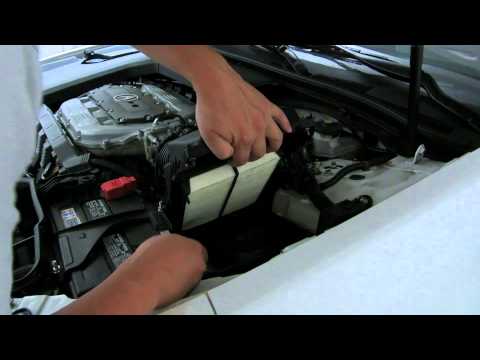
Locate the air filter housing — the black plastic box feeding the intake hose. On this 2.5L there are no sensors or wiring connectors to unplug before opening the housing. Release the housing's clips or screws and lift the lid or separate the halves.
4
Clean out the empty housing
Wipe the inside clean with a dry rag and pick out debris by hand. Don't use water or cleaning sprays inside the housing, and keep the intake opening covered with the rag while you work so nothing falls into the intake.
🔧 Mechanic's note — Tom Becker
Cover the intake opening with the rag and keep it there — a dry rag, no sprays, no water in the housing. I've seen someone wash a housing out and the first start sucked water straight toward the engine.
5
Install the new filter and close the housing
Drop the new rectangular panel filter into the housing in the same orientation the old one came out, making sure it sits flat and the sealing edge is even all the way around. Close the housing lid over it. The housing's clips or screws need to be held in a slightly raised position so they lock into place as you close the housing — take a moment to confirm each one is properly engaged rather than just resting on top. A filter that is cocked sideways or a lid that is not fully latched will let unfiltered air into the engine, so double-check the fit before moving on.
6
Reconnect the intake hose and tighten everything
Slide the hose on squarely rather than forcing it — work it on, then snug the clamp screw. Go around the housing and confirm every clip and screw is tight.
7
Close the hood, start up, and verify the job
Close the hood, start the engine, and idle a minute. Take a short test drive; if a check-engine light appears or the idle is rough, recheck the filter seating, the housing closure, and the hose clamp.
All Done!
Test your repair before closing everything up. If something doesn't work right, double-check your steps.
⚠️ Common Mistakes to Avoid
- • Prying the engine cover off with a screwdriver instead of pulling it straight up — the four rubber grommets release with a steady upward pull; prying snaps the plastic mounting tabs.
- • Forcing the intake hose back onto the housing at an angle — it slides on easily when worked on squarely; forcing it can crack the plastic duct or leave a gap that leaks unmetered air.
- • Closing the air filter housing without confirming each clip or screw is locked in its raised position — an unlatched lid lets dirty air bypass the filter.
- • Installing the new filter in the wrong orientation — match the way the old filter sat, with the sealing edge even all around.