Stop Paying Someone to Do a 5-Minute Job
I'm about to save you money on the easiest car maintenance job that exists. No special tools required. No jacking up the car. No getting dirty. Just pop the hood and swap a filter.
Yet shops charge $40-60 for this. Quick-lube places love upselling air filters because it's pure profit for almost zero work.
Let me teach you how to do this yourself and stop wasting money.
What Does the Air Filter Actually Do?
 Your engine is basically an air pump. It sucks in air, mixes it with fuel, and burns it. The air filter sits between outside air and your engine, filtering out:
- Dirt and dust
- Pollen and leaves
- Insects and debris
- Road grime
- Anything else flying around
A clean filter lets maximum airflow through while catching contaminants. A dirty filter restricts airflow, which causes:
- Reduced power (engine can't breathe)
- Worse fuel economy (computer adds more fuel to compensate)
- Rough idle
- Sluggish acceleration
- Eventually, engine damage (dirt getting through worn filter)
How Often Should You Replace It?
Manufacturer recommendation: Usually 15,000-30,000 miles or 1-2 years
Reality check (from my experience):
- Clean environment, highway driving: 20,000-30,000 miles
- Normal mixed driving: 15,000-20,000 miles
- Dusty/dirty environment: 10,000-15,000 miles
- Lots of dirt roads: 5,000-10,000 miles
- Construction zones regularly: Check every 5,000 miles
The best way: Check it yourself every oil change. Takes 30 seconds.
Factors that shorten filter life:
- Driving on dirt roads
- Living in dry, dusty climates (Arizona, New Mexico)
- Construction areas
- Agricultural areas (harvest season kicks up dust)
- Off-roading
Don't believe the shop when they say: "Your air filter is really dirty, needs replacement" without showing you. Some shops will show you someone else's nasty filter to scare you.
How to Check If Your Air Filter Needs Replacement
 This is SO easy. Here's how:
Visual inspection:
- Pop the hood
- Locate the air filter box (I'll tell you where in a minute)
- Open it up (usually clips or screws)
- Pull out the filter
- Look at it
What you're looking for:
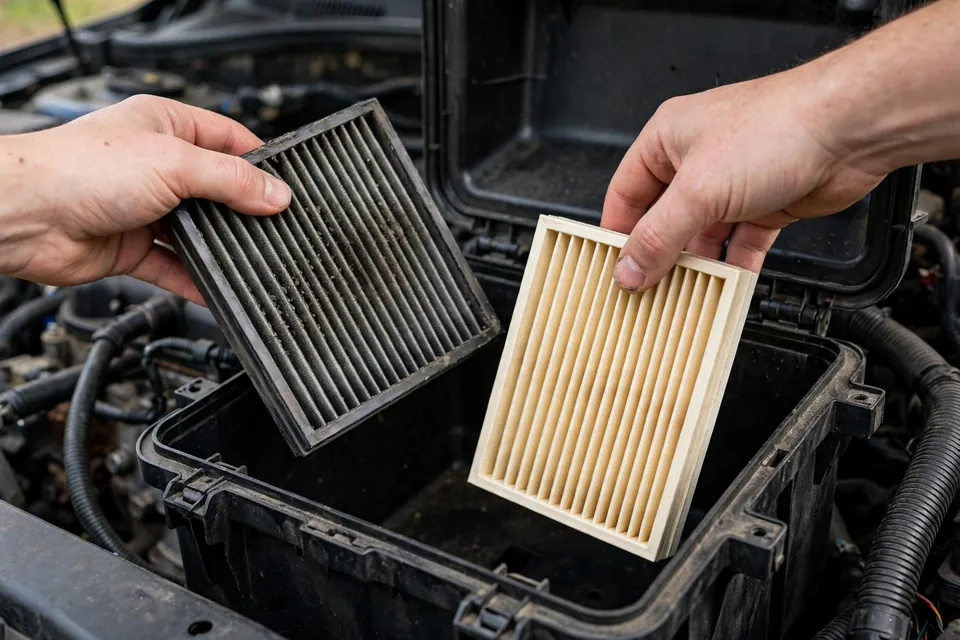
REPLACE if:
- Very dark/black (should be white or light colored originally)
- Clogged with dirt/debris you can see
- Torn or damaged
- Oil-soaked (indicates engine problem)
- Rodent damage (yes, mice love nesting in air boxes)
STILL GOOD if:
- Slightly dirty but you can still see light through it
- Minor dust but not caked on
- No damage or tears
- Original color still visible
The Light Test: Hold the filter up to a bright light. If you can see light coming through most of it, it's probably fine. If it's mostly blocked, replace it.
The Tap Test: Tap the filter against your hand or the ground. Lots of dust falls out? It's working, but getting full. Cloud of dust? Definitely time to replace.
Where Is the Air Filter Located?
Most common locations:
Modern cars (2000+):
- Large black plastic box near the front of engine compartment
- Usually on the driver's side
- Has a large intake tube going to it
- Square or rectangular box
Older cars:
- Round metal or plastic housing on top of engine
- Looks like a giant hockey puck
- Very obvious
Some Hondas/Acuras:
- Behind/under the glove box (cabin filter)
- Wait no, that's cabin filter (different thing)
- Engine air filter still under hood
Trucks/SUVs:
- Usually on driver's side of engine bay
- Sometimes HUGE (diesels especially)
- Might have a snorkel-style intake
European cars:
- Often buried under plastic covers
- Might require removing covers first
- Check manual if you can't find it
If you can't find it: Check your owner's manual. It'll show you exactly where.
How to Replace It (Literally Anyone Can Do This)
 I'm going to walk you through this step-by-step. It's so easy you'll laugh at yourself for ever paying someone.
Step 1: Buy the Right Filter
Go to:
- Auto parts store (they'll look up your car)
- Amazon (search your year/make/model + air filter)
- Walmart automotive section
- Online auto parts retailers
Cost: $10-25 usually
Make sure you get:
- Correct size/shape for your vehicle
- Quality brand (K&N, WIX, Fram, etc.)
- Don't cheap out on $5 generic filters
Step 2: Open the Air Box
Most common types:
Clips (most modern cars):
- Metal spring clips on sides
- Squeeze and lift
- Or pop off with your fingers
- Usually 4 clips total
Screws (some cars):
- Phillips head or Torx screws
- Usually 4-6 screws
- Remove all screws (keep them safe)
- Lift lid off
Wing nuts (older cars):
- Twist counterclockwise by hand
- Lift lid off
Wingnut alternative (some Hondas):
- One screw in center
- Loosen (don't remove completely)
- Twist housing and lift
Step 3: Remove Old Filter
Literally just pull it out. That's it. Sometimes there's a slight lip to clear, but it just lifts out.
Check the air box while you're there:
- Look for leaves, debris, water
- Look for rodent nests (I've seen this)
- Wipe out any loose dirt with a rag
- Make sure intake tube is connected properly
Step 4: Install New Filter
Important: Air filters have a direction sometimes. Check for arrows on the frame showing airflow direction.
Usually: Rubber seal faces down toward engine
- Lower new filter into air box
- Make sure it seats properly all around
- Check that rubber seal is making contact
- Wiggle it to ensure it's seated
Step 5: Close It Up
Reverse of opening:
Clips: Snap them back in place Screws: Tighten them down (snug, not gorilla-tight) Wing nuts: Tighten by hand (no tools needed)
Step 6: You're Done
Seriously. That's it. Took you 5 minutes max once you did it the first time.
Total time: 5-10 minutes Total cost: $10-25 Shop charges: $40-60 Your savings: $15-50
Do this yourself instead of paying the shop, and over 10 years you'll save $300-500. For a 5-minute job.
Related guide: 2017-2026 Mazda CX-5 - Engine Air Filter Replacement — the full photo walkthrough of swapping an engine air filter on a real car.
Common Mistakes People Make
1. Installing It Backwards
Some filters have directional airflow. Installing it backwards can restrict flow. Check for arrows on the filter frame.
2. Not Seating It Properly
If the filter isn't seated all the way around, unfiltered air can bypass it. Push down and check all edges.
3. Forgetting to Secure the Air Box
If you leave clips undone or screws loose, the lid can pop open while driving. Leaves and debris will go straight into your engine. Bad.
4. Buying the Wrong Size
Measure or bring your old filter to the store. Don't just guess based on your car year/make/model. Sometimes there are multiple options.
5. Using Those "Reusable" Filters Wrong
K&N and other reusable filters need specific cleaning products and oil. If you don't maintain them right, they can actually damage your engine. For most people, disposable paper filters are better.
Regular Filters vs. High-Performance Filters
 Paper Disposable Filters (Standard)
Pros:
- Cheap ($10-20)
- Filter very well
- Easy to replace
- What your car was designed for
Cons:
- Disposable (waste)
- Need to replace regularly
Best for: the vast majority of drivers
Reusable Oiled Filters (K&N, etc.)
Pros:
- Last lifetime of vehicle (if maintained)
- Better airflow (slight power gain)
- Environmental (less waste)
Cons:
- Expensive up front ($50-80)
- Need special cleaning kit ($15)
- Need to clean/re-oil every 50k miles
- Can damage MAF sensor if over-oiled
- Slightly worse filtration
Best for: Enthusiasts, people who keep cars long-term
My take: For most people, stick with standard paper filters. The performance gain from K&N is like 2-3 horsepower (you won't feel it). Not worth the hassle and risk.
What About Cabin Air Filters?
Wait, there's TWO air filters?
Yes! Most modern cars have:
- Engine air filter (what we've been talking about)
- Cabin air filter (filters air coming into the car)
Cabin filter location varies:
- Behind glove box (most common)
- Under dashboard
- Under hood near windshield base
- Near the firewall
Cabin filter replacement:
- Also easy DIY (10-15 minutes)
- Shops also overcharge for this ($30-50)
- Change every 15,000-25,000 miles
- Or when AC/heat smells musty
Related guide: 2007-2012 Nissan Altima - Cabin Air Filter Replacement — same 5-minute job, different filter — here's the cabin filter version.
Signs You Need a New Air Filter (Without Looking at It)
Performance symptoms:
- Reduced acceleration
- Engine feels sluggish
- Unusual engine sounds
- Rough idle
Fuel economy symptoms:
- MPG suddenly drops 1-2 MPG
- More frequent fill-ups
Visual clue:
- Black smoke from exhaust (running rich)
- Car struggles to rev
But honestly? Just check it visually every few months. Takes 2 minutes.
Can a Dirty Air Filter Actually Damage Your Engine?
Yes, but it takes a REALLY neglected filter.
What happens with a severely neglected filter:
- Filter gets completely clogged
- Engine can't get enough air
- Vacuum increases in intake system
- Filter can collapse or tear
- Dirt bypasses damaged filter
- Dirt enters engine
- Dirt acts like sandpaper on cylinder walls
- Engine wear accelerates
- Eventually: engine damage
Reality: You'd have to ignore it for YEARS for this to happen. And your car would run terribly long before engine damage occurred.
More common problem: Reduced fuel economy and performance from restricted airflow.
Should You Clean Your Air Filter Instead of Replacing?
For paper filters: No.
Some people try:
- Blowing it out with compressed air
- Tapping it to remove dust
- Washing it
Don't do this. Paper filters are cheap. Just replace them.
Blowing them out can:
- Damage the filter media
- Not remove embedded dirt
- Create tears you can't see
Just buy a new $15 filter.
For K&N/reusable filters: Yes, that's the whole point. But follow their cleaning instructions exactly.
The Shop's Air Filter Upsell Scam
Let me tell you how this works — I run Delgado Auto Repair in Queens:
The pitch: "Your air filter is really dirty. We recommend replacing it. It's only $40."
What they don't tell you:
- The filter costs them $8
- It takes 3 minutes to replace
- Your filter might not actually be that dirty
- They make $30+ profit on this
How to avoid it:
- Ask to see your filter. A good shop will show you. If it's dirty, you'll see it.
- Know when you last replaced it. If it was 5,000 miles ago, it's not due.
- Say you'll check it yourself. Most shops back off.
- Just replace it yourself - you'll know it's done right.
Red flags:
- They won't show you the filter
- They pressure you hard
- They claim it's "urgent" or "safety issue"
- Price is over $50 for standard paper filter
Legit concerns:
- They show you a truly dirty/damaged filter
- They don't pressure you, just recommend it
- It's been 20,000+ miles since last change
- You drive in dusty conditions
The Bottom Line
Air filter replacement is THE easiest car maintenance job. If you've never worked on a car before in your life, this is where you start.
Why do it yourself:
- Saves $30-40 every time
- Takes 5 minutes
- Requires zero tools (usually)
- Zero risk of screwing it up
- You know it was done right
When to replace:
- Every 15,000-30,000 miles
- When it looks dirty/clogged
- When performance drops
- When gas mileage drops
What it costs:
- DIY: $10-25 for filter
- Shop: $40-60
- Savings: $15-50 per change
Over the life of your car, doing this yourself saves you several hundred dollars. For a job that takes 5 minutes.
Stop paying shops for this. Seriously. You can do it.
First time doing it: Check YouTube for "[your car] air filter replacement." You'll find a video of someone doing it on your exact car in 5 minutes.
Questions? Ask below. This is too easy not to do yourself.
- Ray Delgado, ASE Master Technician
Last reviewed: October 2026.