The $500 Service That Prevents $5,000 Engine Failure
Timing belt replacement might be the most important maintenance item on your car. Miss it, and you could destroy your engine in seconds.
I've seen engines with bent valves, damaged pistons, and destroyed cylinder heads - all from ignoring timing belt replacement. These aren't repairs - they're engine replacements or rebuilds costing $3,000-8,000.
All preventable with a $500-1,200 service.
Let me explain why this matters so much and how to avoid catastrophic failure.
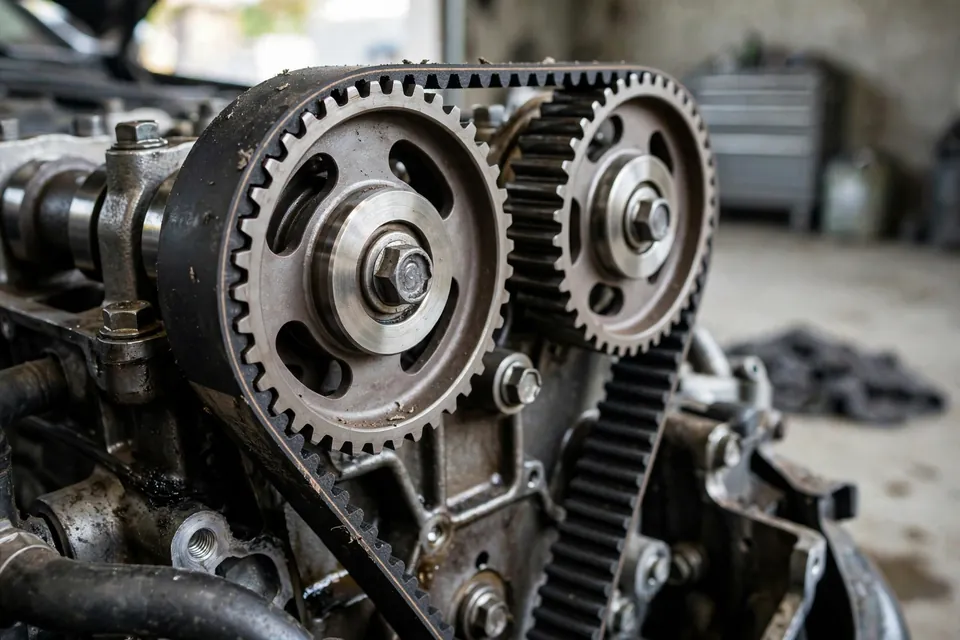
What a Timing Belt Actually Does
Your engine has two main rotating assemblies:
Crankshaft (bottom):
- Connected to pistons
- Converts up-and-down motion to rotation
- Powers the car
Camshaft(s) (top):
- Opens and closes valves
- Controls when air/fuel enters and exhaust exits
- Must be precisely timed to crankshaft
The timing belt (or chain) connects these two and maintains perfect synchronization.
Why timing is critical:
Valves must open and close at exactly the right moment:
- Piston goes down, intake valve opens (air/fuel in)
- Piston goes up, valves close (compression)
- Spark fires, combustion happens
- Piston goes down (power)
- Exhaust valve opens, piston goes up (exhaust out)
If timing is off even slightly:
- Engine runs poorly
- Power loss
- Won't start
If timing belt breaks while running:
On an interference engine (most modern engines), pistons hit valves. Catastrophic damage occurs instantly.
Timing Belt vs. Timing Chain
First, figure out which you have:
Timing Belt
What it is: Rubber belt with teeth, like a giant serpentine belt
Lifespan: 60,000-105,000 miles (depends on manufacturer)
Pros:
- Quieter operation
- Less expensive initially
- Lighter weight
Cons:
- Wears out and MUST be replaced
- Failure causes catastrophic engine damage
- Can fail without warning
- Affected by oil leaks
Found in:
- Many Honda, Toyota, Subaru engines
- Most 4-cylinder imports
- Some domestic 4-cylinders
- Older V6 engines
Timing Chain
What it is: Metal chain, like bicycle chain but larger
Lifespan: 150,000-300,000+ miles (often lifetime of engine)
Pros:
- Much longer life
- Usually doesn't need replacement
- More durable
- Less affected by environment
Cons:
- Noisier (some whine/rattle)
- More expensive to manufacture
- Can stretch over time
- When they DO fail, expensive repair
Found in:
- Most modern engines (2010+)
- American V8s
- BMW, Mercedes, Audi
- Many newer Toyota, Honda, Nissan
How to know which you have: Check your owner's manual or Google "[year make model] timing belt or chain"
When to Replace Timing Belt
Follow manufacturer recommendation EXACTLY.
Common intervals:
- 60,000 miles (older Hondas, some Toyotas)
- 90,000-100,000 miles (most common)
- 105,000 miles (some Subaru)
AND/OR time-based:
- Many specify "or 10 years, whichever comes first"
- Rubber degrades from age even with low miles
My recommendation:
If your car has:
- 80,000 miles and is 8 years old
- Replace it even though interval is 100,000 miles
- Age matters as much as mileage
Don't gamble. The belt costs $80. The labor is $400-1,000. But if it breaks? $5,000+ engine damage.
Warning Signs of Timing Belt Failure
Here's the scary part: timing belts usually give NO WARNING before they break.
But sometimes you see:
Ticking or tapping noise from engine:
- Belt teeth wearing/skipping
- Pulleys wearing
- Tensioner failing
Engine misfires or runs rough:
- Belt has jumped a tooth
- Timing is off slightly
Oil leaks near timing cover:
- Can contaminate belt
- Accelerates belt deterioration
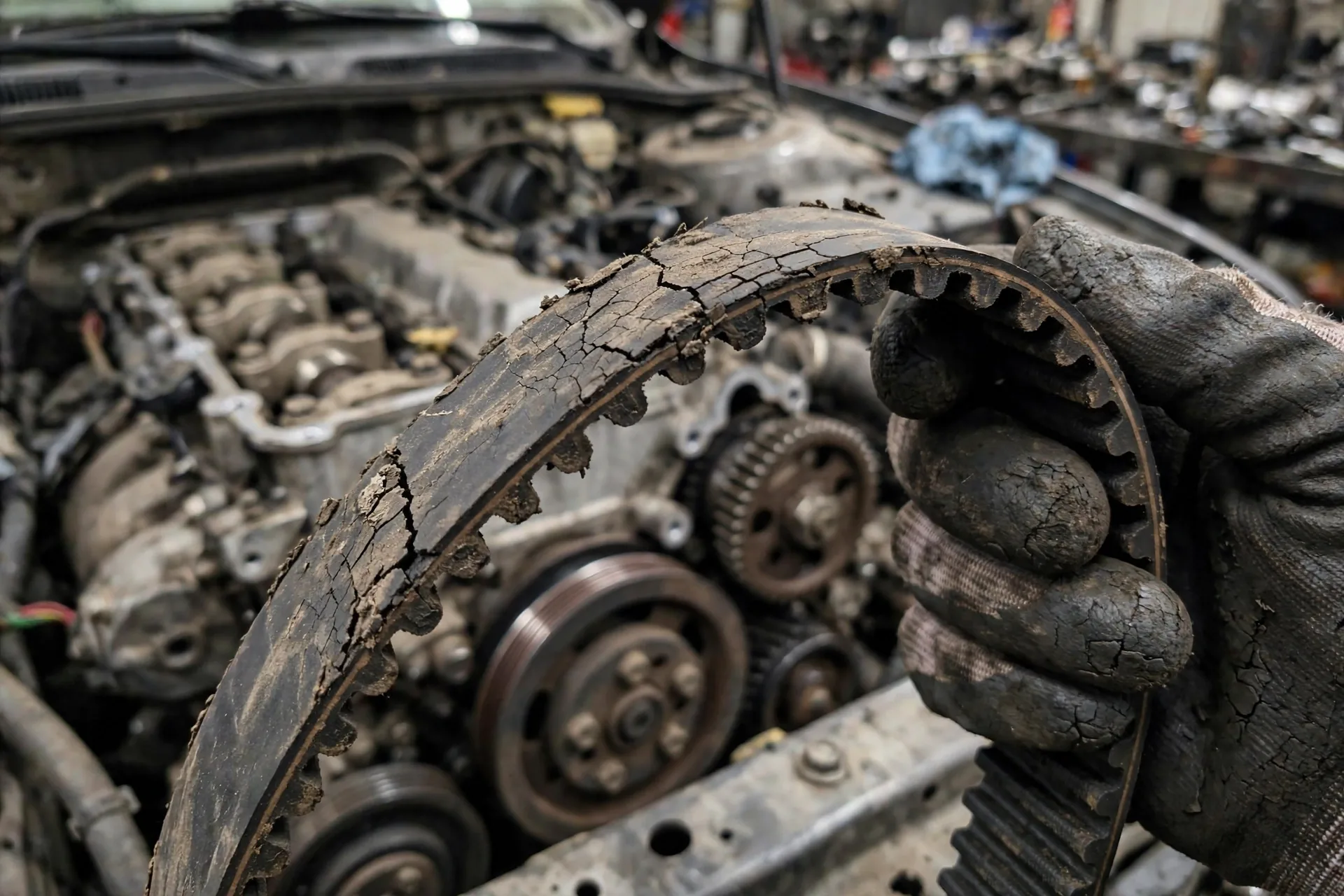
Visible cracks on belt (if you can see it):
- Rubber is deteriorating
- Failure imminent
The reality: Most belts break without any warning at all. That's why you replace by mileage/age, not by condition.
Interference vs. Non-Interference Engines
This determines whether a broken belt destroys your engine or just leaves you stranded.
Interference Engine (Most Modern Engines)
What it means: When pistons reach top of stroke, they occupy the same space the valves occupy when open.
Normal operation: Timing keeps pistons and valves from ever being in that space at the same time.
If belt breaks:
- Camshaft stops
- Valves stay open or closed (wherever they were)
- Crankshaft keeps spinning (from inertia)
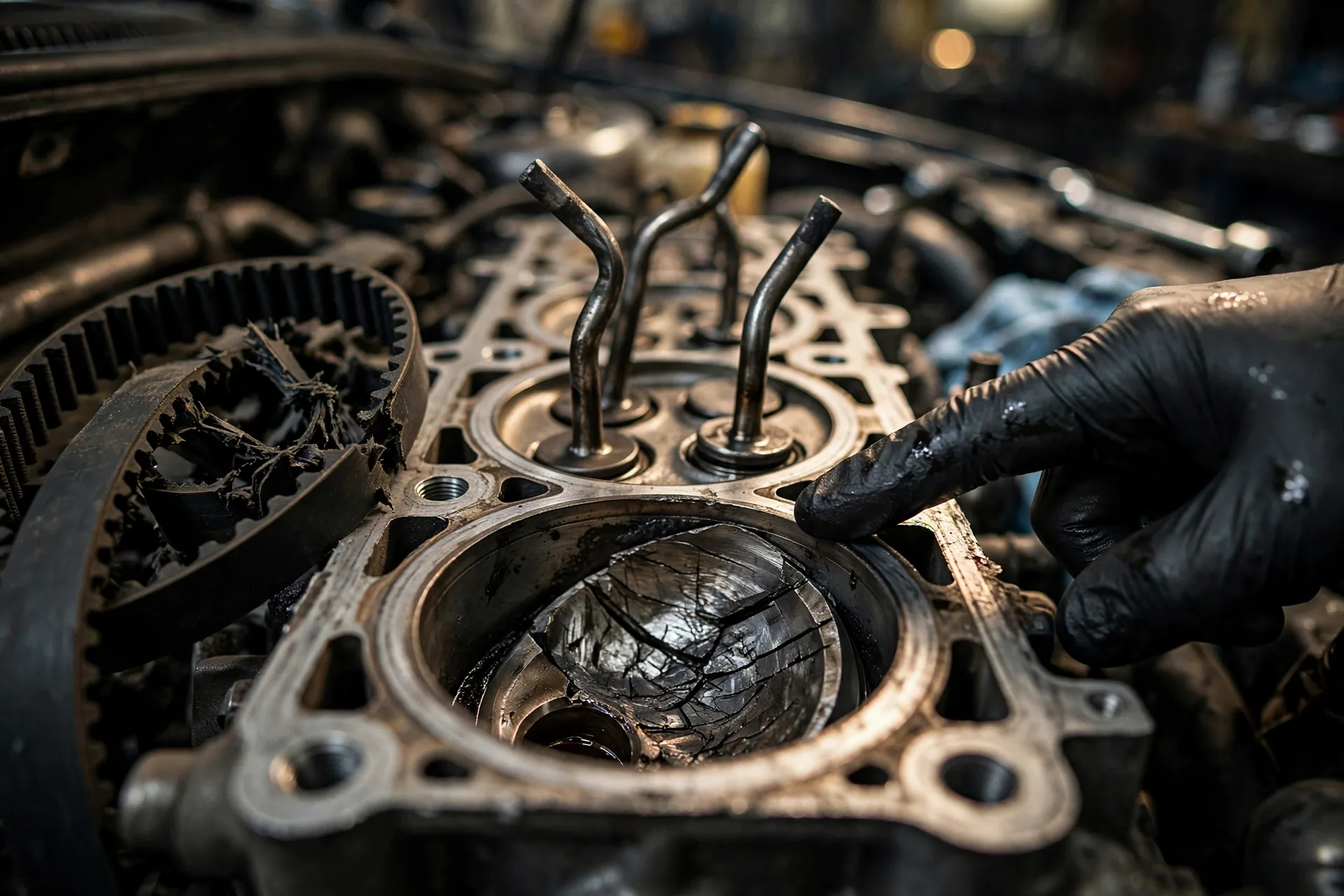
- Pistons slam into open valves
- INSTANT catastrophic damage:
- Bent/broken valves
- Damaged pistons
- Damaged cylinder head
- Possibly damaged block
Repair cost: $3,000-8,000 (often not worth fixing)
Examples:
- Most Honda engines
- Most modern Toyota engines
- All Subaru engines
- Most turbocharged engines
- Most DOHC engines
Non-Interference Engine (Older/Some Engines)
What it means: Even at top of stroke, pistons don't hit valves
If belt breaks:
- Engine stops immediately
- No internal damage
- Replace belt, car runs fine
Repair cost: $500-1,200 (just the belt job)
Examples:
- Some older Honda engines
- Some Toyota engines (specific models)
- Many older domestic engines
How to know: Google "[year make model engine] interference or non-interference"
Important: Even non-interference engines can have damage if belt breaks at high RPM. Don't gamble.
What Gets Replaced During Timing Belt Service
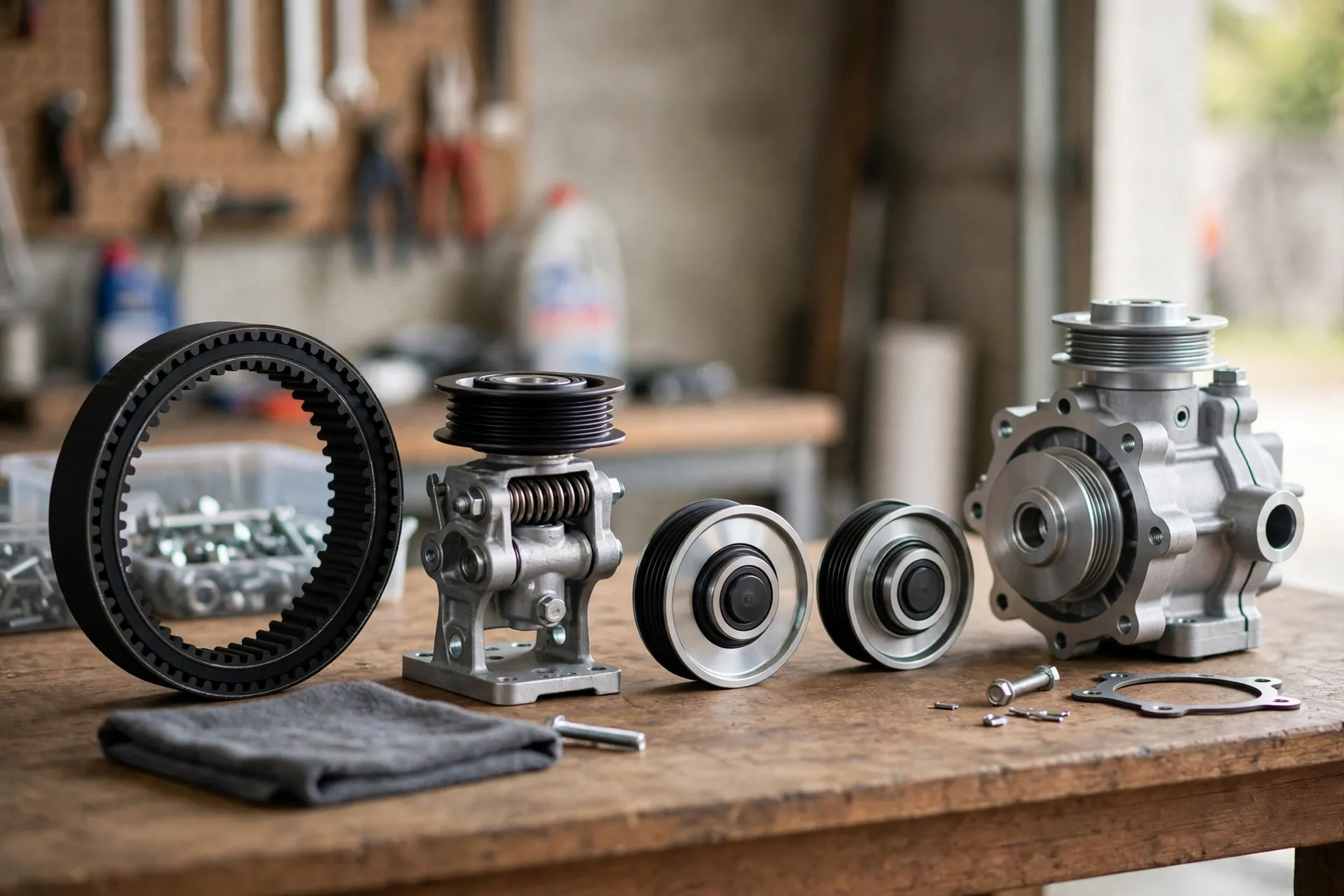
A proper timing belt job isn't just the belt:
Always Replace:
Timing belt - obviously
Tensioner - keeps belt tight
- Wears out same time as belt
- If tensioner fails, new belt fails
- Always include this
Idler pulleys - guides belt path
- Bearings wear out
- If pulley seizes, belt breaks
- Always include these
Highly Recommended:
Water pump - often driven by timing belt
- Same labor to access
- If it fails later, you pay labor twice
- Add $50-150 in parts, saves $500+ in future labor
- I ALWAYS recommend replacing it
Timing cover seals
- Crankshaft seal
- Camshaft seal(s)
- While you're in there, cheap insurance
Sometimes Needed:
Valve cover gasket - might leak after opening it up
Thermostat - easy to access during timing belt job
Drive belts - serpentine belt removed anyway, might as well replace if due
Related guide: 2012-2019 Fiat 500 - Timing Belt & Water Pump Replacement — The water pump almost always gets replaced with the belt — here is the combined job.
The Timing Belt Job Process
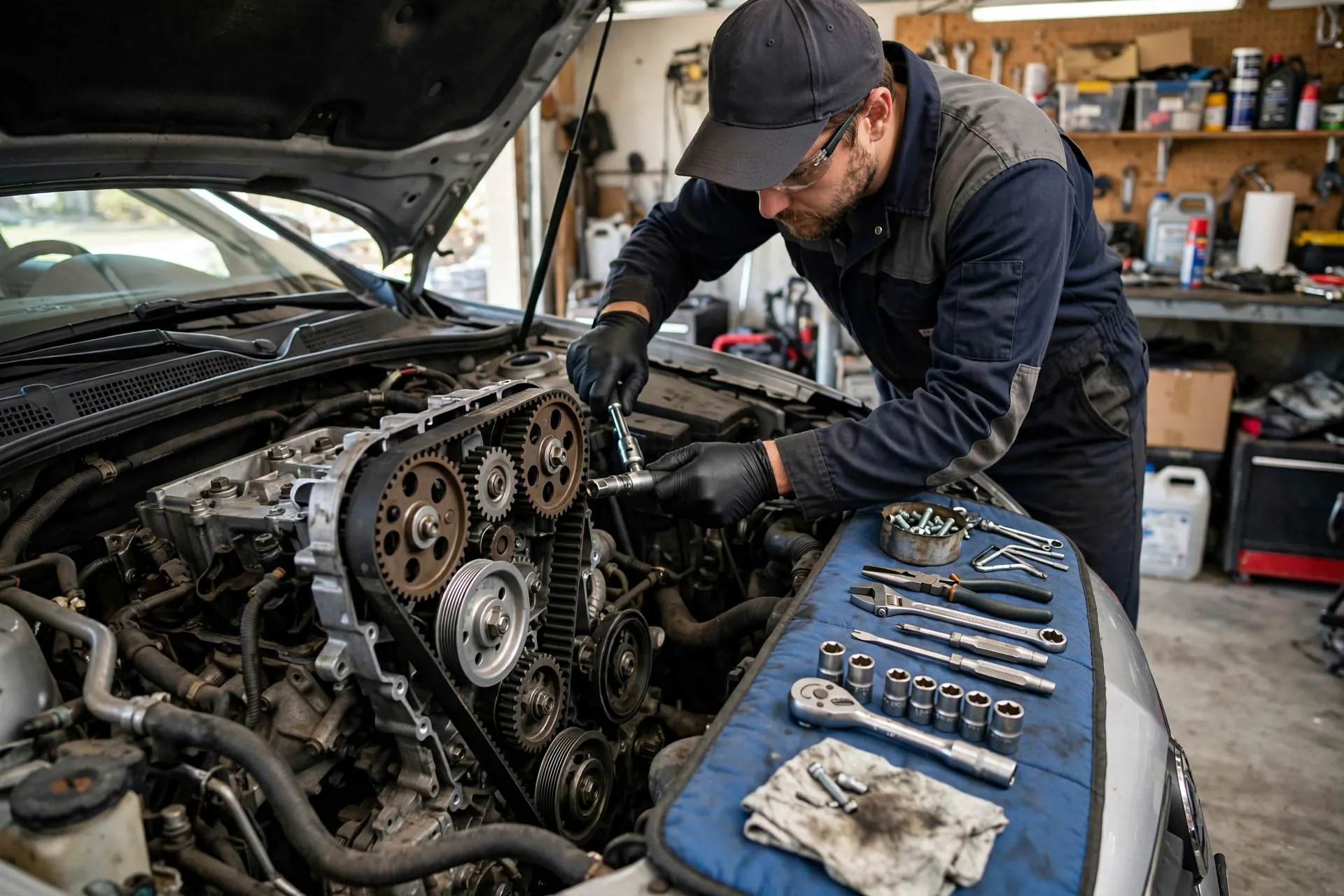
This is a complex job. Not recommended for beginners.
Difficulty: 8/10 Time: 4-8 hours (first time) Special tools required: Yes
Why it's difficult:
- Must maintain precise timing - off by one tooth = rough running or timing codes; bigger timing mistakes on an interference engine = engine damage
- Requires special tools - crank locks, cam locks
- Must lock engine in exact position - TDC (Top Dead Center)
- Torque specs critical - incorrect = failure
- Multiple timing marks - must align perfectly
- Can't make mistakes - wrong reinstallation = destroyed engine
General process:
- Disconnect battery
- Remove accessories in the way (belts, alternator, power steering, etc.)
- Remove timing cover
- Rotate engine to TDC (timing marks aligned)
- Lock crankshaft and camshaft(s) in position
- Remove old belt
- Inspect all components
- Replace tensioner and idler pulleys
- Replace water pump if doing it
- Install new timing belt (follow specific routing)
- Set tension precisely
- Verify all timing marks aligned
- Manually rotate engine 2 complete revolutions
- Recheck timing marks
- If aligned, install covers
- Reinstall accessories
- Start engine and verify proper operation
Critical points:
- Timing marks MUST align exactly
- Must rotate engine by hand BEFORE starting to verify no interference
- Tension must be precise (too loose = jumps teeth, too tight = premature failure)
If you mess up: Engine won't run, or worse, damage occurs immediately on startup
My advice: Unless you're experienced and have proper tools, pay a professional.
DIY vs. Professional
DIY pros:
- Save $400-800 in labor
- Learn valuable skill
- Satisfaction of doing it yourself
DIY cons:
- Need special tools ($100-300)
- 6-8 hours first time
- High stakes (mistake = destroyed engine)
- Must follow service manual precisely
Professional pros:
- Warranty on work (typically 1 year or more)
- Done in 1 day
- Proper tools and experience
- Peace of mind
- They'll catch other issues while in there
Professional cons:
- More expensive ($600-1,500 total)
My take:
If you:
- Have experience with engine work
- Have the tools or can rent them
- Have a detailed service manual
- Have time
- Are confident
Then DIY can work.
If not? Pay the shop. This isn't the job to learn on. Mistakes are too expensive.
Related guide: 2015-2019 Volkswagen Passat - Timing Belt Replacement — See what the full timing belt job looks like on a real car before deciding DIY or shop.
Cost Breakdown
Parts only (DIY):
- Timing belt kit (belt, tensioner, pulleys): $100-250
- Water pump: $50-150
- Coolant: $20
- Seals: $30-50
- Total parts: $200-450
Professional service:
- Parts: $200-450
- Labor: 3-6 hours at $100-150/hour
- Total: $600-1,500
Varies by car:
- 4-cylinder easy access: $600-900
- V6 or difficult access: $1,000-1,500
- Luxury/European: $1,500-2,500
- Subaru (horizontal engine): $1,200-1,800
If belt breaks (interference engine):
- Inspection: $200-500
- Valve job: $1,500-3,000
- Head gasket while apart: +$1,000
- If pistons damaged: $3,000-5,000
- Possible engine replacement: $4,000-8,000
$1,000 maintenance vs. $5,000 repair. Easy math.
Timing Chain Issues
Chains usually last longer, but they have problems too:
Stretched Chain
Symptoms:
- Rattling noise on cold start
- Check engine light (timing codes)
- Rough idle
- Reduced performance
Cause: Wear over high mileage, poor oil maintenance
Fix: Replace chain, guides, tensioner ($800-2,500)
Failed Tensioner
Symptoms:
- Loud rattling from engine
- Timing codes
Cause: Plastic tensioner breaks, oil pressure issue
Fix: Replace tensioner, possibly chain ($500-1,500)
Worn Guides
Symptoms:
- Rattling, especially on startup
- Plastic pieces in oil pan
Cause: Plastic guides wear from chain slap
Fix: Replace guides and chain ($1,000-2,500)
Preventing chain issues:
- Change oil on your manufacturer's schedule (often 5,000–7,500 miles)
- Use correct oil viscosity
- Don't run engine low on oil
- Address oil leaks promptly
Chains last longer than belts but aren't maintenance-free.
Related guide: 2009-2016 Audi A4 - Water Pump Replacement — On chain-driven engines the water pump is its own job — here is a full replacement walkthrough.
Common Timing Belt Questions
Q: Can I go 10,000 more miles?
A: Would you gamble $5,000 to save $1,000? That's what you're doing. Replace it on schedule.
Q: My car only has 40,000 miles but is 12 years old. Do I need it?
A: Yes. Age matters as much as mileage. Rubber degrades from heat cycles and age.
Q: Can I replace just the belt and not the other parts?
A: Technically yes, but stupid. If tensioner fails at 10,000 miles, you pay for the whole job again. Do it right once.
Q: Should I replace the water pump?
A: Absolutely yes — if your water pump is driven by the timing belt. Same labor. If yours runs off the accessory belt instead, it's a separate job. If water pump fails 20,000 miles later, you pay full labor cost again. Add $50-150 now, save $500+ later.
Q: How do I know if my belt already broke?
A: Engine won't start, won't crank, or cranks but doesn't start. Don't try starting it multiple times - you'll cause more damage.
Q: My engine has a chain. Do I need to replace it?
A: Probably not, unless you have symptoms (rattling, codes). But check oil regularly and change on schedule.
Q: Can I do this myself?
A: If you're mechanically skilled, have tools, and have done engine work - maybe. If not, pay professional. Stakes are too high.
What Shops Try to Upsell
Legitimate timing belt job includes belt, tensioner, pulleys, and ideally water pump.
Reasonable recommendations:
- Water pump (do it)
- Seals (do it)
- Drive belts if due (do it)
- Coolant flush since system is open (do it)
Questionable upsells:
- Valve cover gasket if not leaking (maybe wait)
- Spark plugs if not due (can do, not critical)
- Full tune-up (separate job)
Red flags:
- Pressure to replace immediately without showing you why
- Quote significantly higher than average for your car
- Refusing to show you the old belt
- Claiming you need it when you're nowhere near interval
Signs of Bad Timing Belt Work
After replacement, watch for:
Immediate (drive it right after):
- Rough running (timing off)
- Check engine light (timing codes)
- Unusual noises
- Coolant leak (if water pump replaced)
- Oil leak (if seals replaced)
Go back immediately if you notice any of these.
First 1,000 miles:
- Belt noise (squealing, chirping)
- Reduced performance
- Misfires
Good shop will:
- Warranty work (typically 1-2 years)
- Test drive after service
- Recheck after 500 miles
- Show you old parts
The Bottom Line
Timing belt replacement is critical maintenance:
If you have a timing belt:
- Replace it at manufacturer interval (usually 90,000-100,000 miles)
- Also replace by age (typically 10 years)
- Always replace tensioner and idlers
- Always do water pump at same time
If you have an interference engine:
- Belt failure = $5,000+ engine damage
- Not worth gambling
- Do it on time
Cost vs. risk:
- Maintenance: $600-1,500
- Engine repair if belt breaks: $3,000-8,000
- Easy decision
If you have a timing chain:
- Usually lasts life of engine
- But change oil regularly
- Address symptoms promptly (rattling)
- Chains can still fail (just less common)
Don't skip this service. It's the most expensive failure to ignore.
I've had customers cry when I showed them their destroyed engine from a broken timing belt. The belt was $80. The labor was $800. They thought they'd save money by waiting.
Now they need a $6,000 engine.
Don't be that person.
Questions? Drop them below.
- Ray Delgado, ASE Master Technician
Last reviewed: October 2026.