Winter Emergency Kit: What to Keep in Your Car
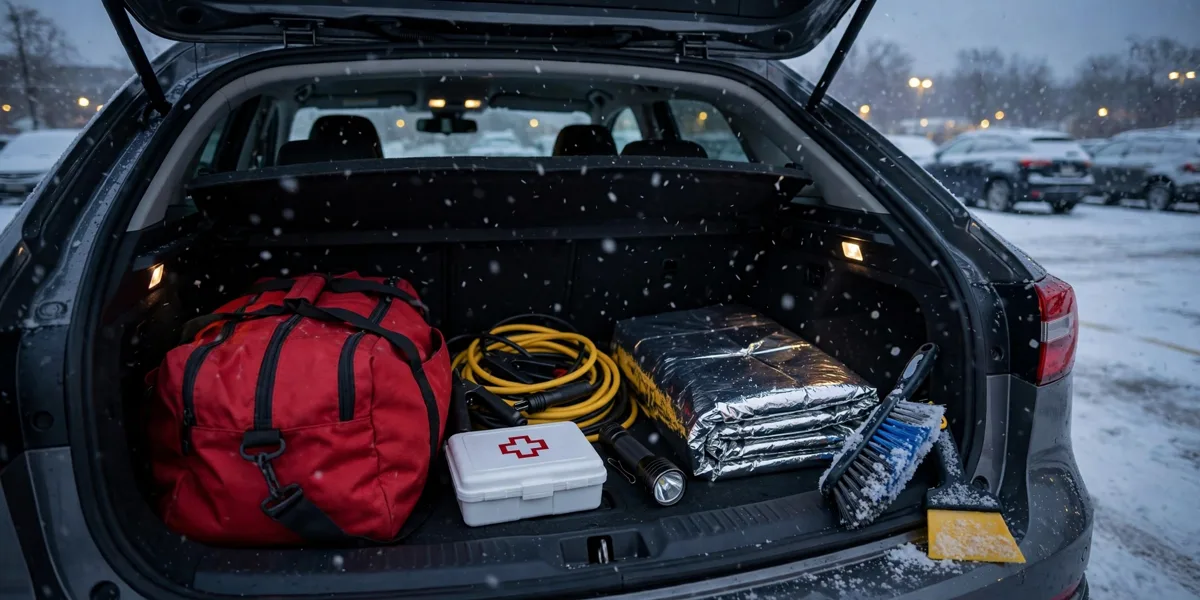
Keep a charged jump starter or good jumper cables, a wool or mylar blanket, a flashlight, an ice scraper and snow brush, a small shovel, and a phone charger in your car all winter. That is the core kit. It covers the three ways winter actually strands people: a dead battery, a car stuck in snow, and cold you cannot escape if help is slow. Everything on this list fits in one trunk corner and takes one afternoon to put together.
Winter breakdowns are different from summer ones because the clock starts working against you. At below-zero wind chills, exposed skin can start developing frostbite in under 30 minutes. A dead battery that would be a mild annoyance in July becomes a real safety problem in January, because you cannot count on the engine running the heater while you wait for help. That is the whole point of this list: every item either gets you moving again or keeps you safe until someone reaches you.
Tires lose roughly 1 psi for every 10 degrees Fahrenheit the temperature drops. Cold air also thickens engine oil and cuts a battery's cranking power. None of this means your car is failing, it means winter asks more from it, and a small kit covers the gap.
The full checklist, in priority order
- Jumper cables or a portable jump starter, and know which terminals go where before you need it.
- A wool blanket or emergency mylar blanket, the kind that folds to the size of a wallet.
- A bright flashlight with fresh batteries, plus a headlamp if you want hands-free.
- A long-handled ice scraper and snow brush.
- A collapsible or short-handled snow shovel.
- Traction boards, or a bag of cat litter or sand as the budget option.
- A phone charger that runs off the 12V outlet, not just a wall brick.
- Warm gloves, a knit hat, and an extra pair of dry socks.
- A few high-calorie snacks that do not freeze solid, like granola bars.
- Bottled water, replaced every few months so it never goes stale.
- A basic first aid kit.
- Road flares or reflective triangles.
If you only buy three things today, make it the jump starter, the blanket, and the flashlight. Those three cover power, warmth, and visibility, which are the actual emergencies.
Jump-start and battery gear
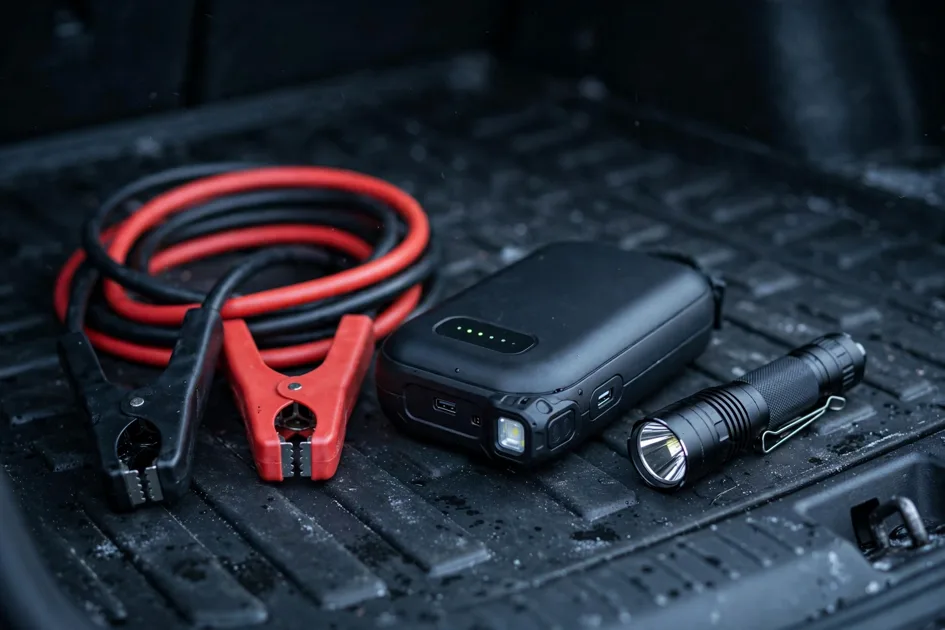
Cold is the number one killer of weak batteries. A battery that limped through October can give up on the first 15-degree morning. Jumper cables are the cheapest option, and they never need charging, but they need a second car. A portable jump starter costs more but lets you self-rescue with no other vehicle around, which is exactly the situation at 6 AM in a dark parking lot. Whichever you carry, keep the jump starter charged: top it off once a month through winter, because lithium packs lose charge sitting in a cold trunk.
The cable order matters, and it is worth learning once instead of googling it with frozen fingers. Red to dead positive, red to donor positive, black to donor negative or bare metal, black to unpainted metal on the dead car. Start the good car, wait a few minutes, then start the dead one. If you want the full step-by-step with photos, our 2019-2024 Chevrolet Silverado - Jump Start walkthrough covers the cable sequence that applies to nearly every gas vehicle, and the blog post How to Jump Start a Car Safely (Step-by-Step DIY) is the quick refresher version. If your battery is more than a few winters old and cranks slowly on cold mornings, read the 2023-2026 Acura Integra — Battery Replacement guide to see how straightforward a swap is before it leaves you stranded.
Stay warm while you wait
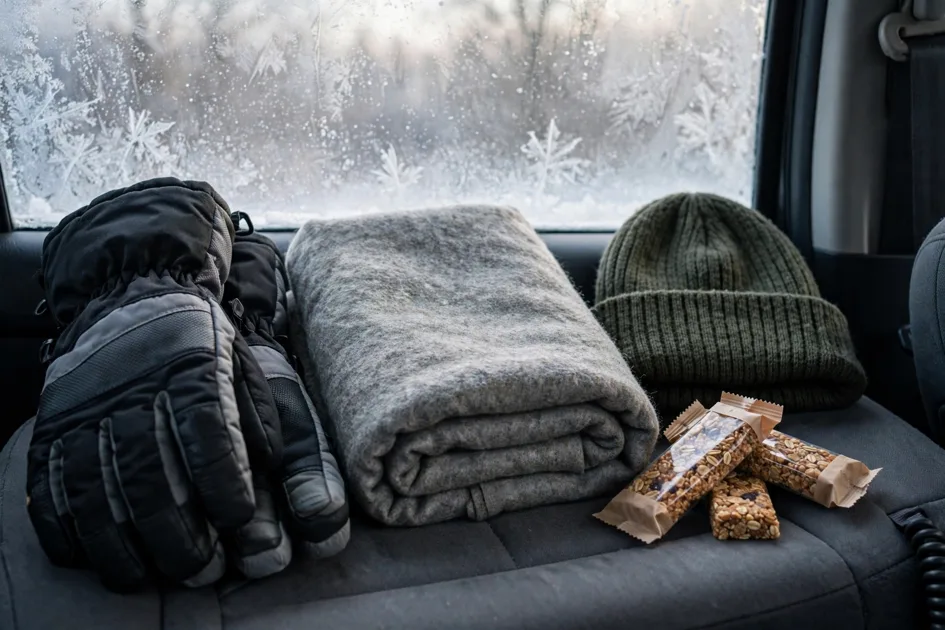
The blanket is the most underrated item in the kit. Your engine may not run, and even if it does, idling with the exhaust buried in snow is dangerous, since carbon monoxide can back up into the cabin. A wool blanket or even a mylar emergency blanket keeps you warm without the engine. Mylar looks flimsy, but it reflects body heat well and weighs nothing, so there is no reason not to have one.
Pack the gloves, hat, and socks even if you are "just running errands." People get stranded in the clothes they wore to the grocery store. Dry socks sound silly until your boots fill with slush while you dig out a tire. The snacks are not about comfort: if you wait two hours for a tow, your body burns calories staying warm, and granola bars or nuts hold up in the cold. Keep the water in the cabin, not the trunk, if you live somewhere it drops below freezing, or it will be a block of ice when you need it.
Get unstuck: traction and digging tools
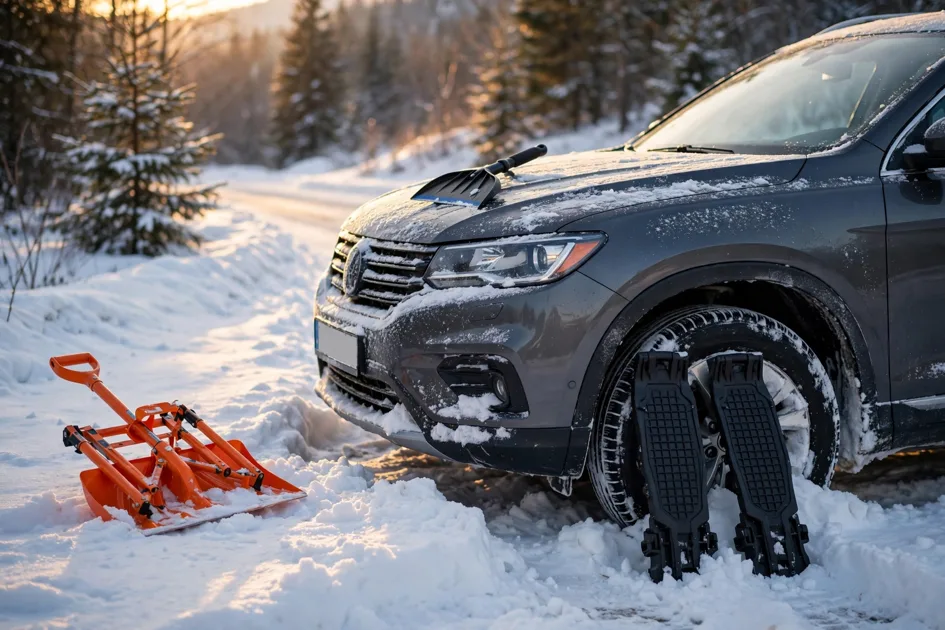
Spinning your tires digs you deeper. The fix is always the same: clear snow from around the tires, put something grippy under the drive wheels, and accelerate gently. A short collapsible shovel clears the snow packed under the car and around the tires in minutes, which is the step most people skip. Traction boards give the tire something to bite on, and you just drive forward onto them and take them with you. The low-budget version is a bag of cat litter or sand poured under the drive wheels, and it works well enough that plenty of northern drivers keep it as their only traction aid.
A note on technique: rock the car. Drive forward a foot, let it roll back, forward again, building momentum each time. Flooring it polishes the snow into ice and makes everything worse. If the wheels spin freely after a few tries, stop and call for help instead of cooking the transmission.
Your tire pressure deserves a mention here too, because the dashboard light is a winter regular. When the temperature drops, the TPMS light pops on even though nothing is leaking, and our post Why Your Tire Pressure Light Comes On in Cold Weather explains exactly why. Check pressures monthly in winter and refill to the number on the driver door jamb sticker, not the number on the tire sidewall. The 2013-2022 Acura ILX — Tire Pressure & Rotation guide walks through the check and refill process for any car. Soft tires grip worse in snow and cost you fuel, so this is a two-minute job that pays for itself.
Visibility and signaling
Other drivers cannot avoid what they cannot see. If you are stopped on a shoulder in blowing snow, turn on the hazards immediately and put a reflective triangle or flare behind the car. The flashlight is for your own work: checking under the hood, reading the manual, or waving down help. A headlamp beats a handheld flashlight for anything that needs both hands, like attaching cables in the dark.
The phone charger is survival gear in 2026. Your phone is your map, your tow-truck call, and your way to tell someone where you are. A dead phone turns a one-hour wait into a real problem. The 12V car charger works even when the battery is too weak to crank the engine in many cases, since accessory power needs far less juice than the starter.
Keep the cooling system ready before winter
An emergency kit handles the breakdown, but one winter maintenance job prevents a common one. Weak or diluted coolant can freeze and crack engine parts in a real cold snap. If you do not know when the coolant was last serviced, check your owner's manual for the interval. The 2018-2024 Chevrolet Equinox - Coolant Flush guide shows what the service involves. This is a once-every-few-years job, and doing it in October is smarter than doing it on the shoulder in February.
What to leave out
Skip the giant pre-packed roadside kits that are mostly filler, and skip anything you have never practiced with. A tow strap is useless if you do not know where your car's tow points are, and the wrong attachment point can rip off a bumper. Skip candles as a heat source inside the car: the fire risk and carbon monoxide risk are not worth it when a blanket does the job. Skip hand warmers as your only warmth plan, they help, but they are a supplement, not a blanket. And skip the idea that all-wheel drive replaces any of this. AWD helps you go, it does not help you stop, start a dead battery, or stay warm.
FAQ
How much does a winter emergency kit cost? Most of it is one-time cheap purchases: a blanket, a shovel, an ice scraper, and cat litter add up to less than a single tow. The jump starter is the priciest item, and it is also the one you will use most. Buy once and keep everything for years.
Where should I store the kit? The trunk or cargo area, packed in one bag or bin so nothing scatters. Keep the blanket, hat, and gloves near the top or in the cabin where you can reach them without opening the trunk in a storm.
Do I really need this if I have roadside assistance? Yes. Roadside assistance is great, but wait times stretch for hours during a snowstorm because everyone calls at once. The kit covers the gap between breaking down and help arriving.
How often should I check the kit? Twice a year, when the clocks change. Check the flashlight batteries, the jump starter charge, the water freshness, and that the shovel and cables are still where you left them. Five minutes, spring and fall.
The takeaway
A winter emergency kit is the highest-return prep a driver can do. It costs an afternoon, it lives quietly in the trunk, and the one morning it saves you pays for every winter after it. Start with the jump starter, the blanket, and the flashlight this weekend, add the shovel and traction aids before the first storm, and practice the cable order once in the driveway. Winter does not forgive the unprepared, but it is completely manageable for the prepared.
Safety: Informational DIY. EZ Car Fix is not a shop or dealer.