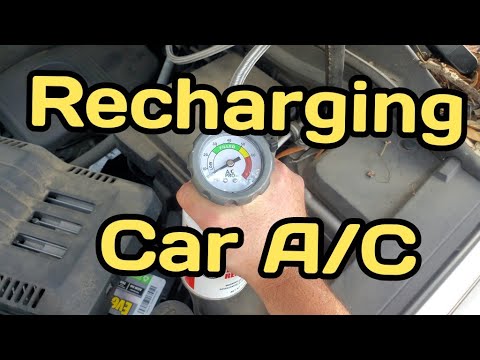
Quick answer: AC Not Blowing Cold / Recharge on a 2022–2024 Honda Civic is rated Moderate and takes about 30-60 minutes. You'll need 2 tools for this job, and parts cost about $45. This guide walks you through the full job step by step, including the mistakes to avoid.
| Part Name |
Part Number |
Price |
Buy |
| Correct refrigerant DIY kit with gauge (R-134a or R-1234yf as labeled) |
— |
$45.00 |
|
| AC leak-detect dye (optional) Optional |
— |
$12.00 |
|
About prices: shown prices are typical retail averages and change frequently; cheaper alternatives may be available. Confirm the current price before buying.
💡 Pro tip: Order all parts at once to save on shipping
Step-by-Step Instructions
Follow these steps carefully
1
Confirm refrigerant type and symptoms
Open the hood of the 2022-2024 Honda Civic and read the A/C specification sticker on the underside of the hood. The eleventh-generation Civic uses R-1234yf refrigerant — Honda switched the Civic to it back in 2016 — so you need an R-1234yf kit with the matching coupler, never an R-134a kit. The owner's manual lists the factory charge as 435-485 g for the 1.5L engine and 445-495 g for the 2.0L. With the engine running and climate set to MAX A/C, confirm the vents blow warm, watch the compressor clutch for engagement, and check the cabin filter behind the glovebox for clogging. Important safety note: Honda labels R-1234yf as a flammable refrigerant and the manual directs service to registered technicians — wear safety glasses and gloves, work in a ventilated area away from open flames, and never vent refrigerant to the air.
🔧 Mechanic's note — Ray Delgado
That charge weight is tiny — about a pound. Most DIY overcharging I see on these comes from treating it like the old R-134a systems that held twice as much.
2
Find the low-side service port
No connection? Confirm you bought the R-1234yf kit and aren't on the high-side line. Never force it. If the system uses POE oil (per the manual), don't add PAG oil or R-134a additives.
🔧 Mechanic's note — Tom Becker
If my old R-134a hose won't click on, I know that's the car protecting me, not a broken fitting — I buy the right R-1234yf kit instead of forcing it.
3
Take a baseline reading
Confirm the clutch spins with the pulley. Read the low side: R-1234yf runs roughly 28–35 psi at 77°F, about 38–46 at 95°F. Near zero running = system empty — Honda calls for a registered technician to evacuate, leak-test, and recharge; don't DIY top-off.
4
Add refrigerant cautiously
Partial charge only: R-1234yf in five-to-ten-second bursts, can upright, shaking gently between bursts. Recheck gauge and vent temp after each; stop in range — overcharging spikes high-side pressure and can damage the compressor. The charge is only about a pound (435–495 g) — a little goes a long way. Never mix refrigerants.
5
Stop and verify cooling
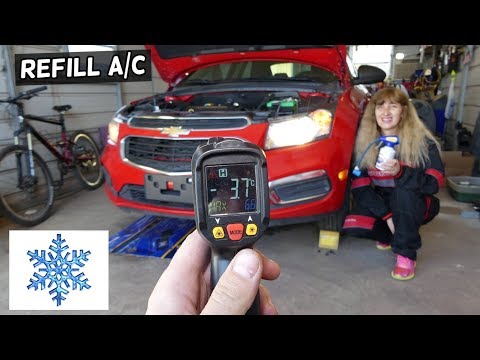
Disconnect, cap finger-tight. Idling with recirculate on, expect roughly 35–50°F at the center vent. Inspect compressor, fittings, condenser for oily residue. Cold fades in days, clutch never engages, or baseline near zero? Take it to a shop for a UV dye leak test instead — R-1234yf is flammable and venting refrigerant is illegal.
All Done!
Test your repair before closing everything up. If something doesn't work right, double-check your steps.
⚠️ Common Mistakes to Avoid
- • Using the wrong refrigerant (R-134a vs R-1234yf)
- • Overcharging by watching a gauge without following the kit chart and vent temperature
- • Recharging an empty or badly leaking system
- • Connecting to the high-side port
- • Continuing to recharge when the system loses cooling again within days